
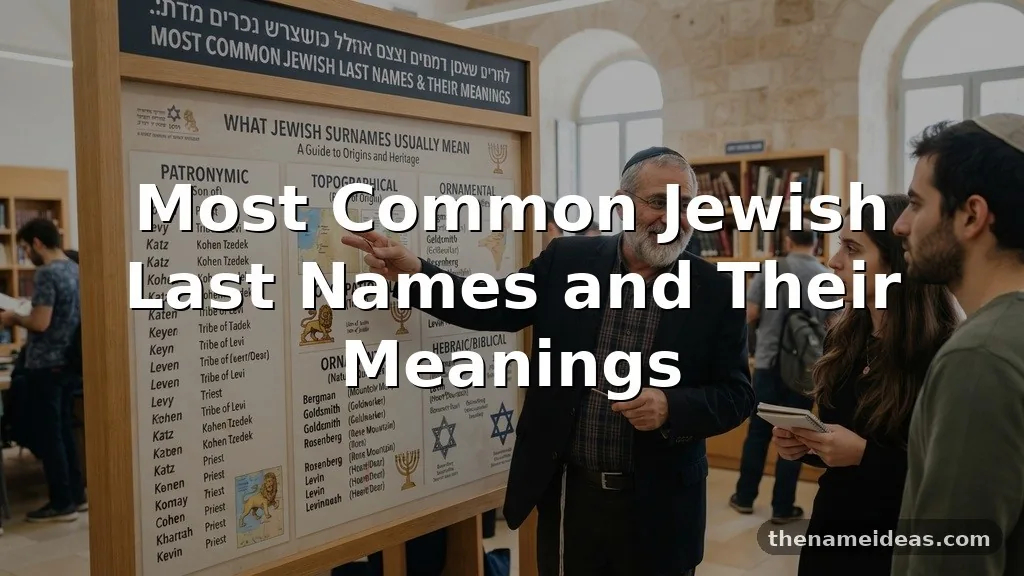
Jewish last names are like tiny history books. Behind names like Cohen, Goldberg, and Abramowitz lie centuries of migration, faith, work, and family — from biblical Israel to the shtetls of Eastern Europe to modern-day Tel Aviv.
Many of these surnames describe an ancestor’s job, hometown, or father’s name, while others were adopted in the 1700s and 1800s when European governments required Jews to take fixed family names. If you’re expecting and weighing first names too, our unusual baby names roundup is worth a browse.
Below you’ll find 300 of the most common Jewish surnames, organized into 10 groups by origin and meaning — from ancient Hebrew roots to Yiddish classics to modern Israeli names.
Hebrew and Biblical-Origin Surnames
The oldest layer of Jewish surnames, drawn from the Hebrew Bible and ancient Israelite tradition — names like Cohen (priest) and Levi (the priestly tribe) survive to this day.
- Aaronson
- Abramson
- Abraham
- Abramowitz
- Aronson
- Baruch
- Ben-Ami
- Ben-Aaron
- Ben-David
- Ben-Ezra
- Ben-Natan
- Ben-Shlomo
- Cohen
- Cohavi
- Davidov
- Davids
- Eleazar
- Emanuel
- Gabriel
- Isaacson
- Isakowitz
- Jacobson
- Jakobson
- Levi
- Levitt
- Levin
- Levison
- Mendelsohn
- Noah
- Samuelson
Yiddish and German-Origin Surnames
Spoken by Ashkenazi Jews for a thousand years, Yiddish and German gave us melodic names built from colors, metals, and nature — Goldberg (gold mountain), Rosenbaum (rose tree).
- Adler
- Bauer
- Berliner
- Berger
- Bernstein
- Blumenthal
- Braun
- Eisenberg
- Feldman
- Fischer
- Friedman
- Goldberg
- Goldstein
- Greenberg
- Grossman
- Hirsch
- Klein
- Kohn
- Krause
- Krauss
- Meyer
- Rosenbaum
- Rosenberg
- Rosenthal
- Rothschild
- Schwartz
- Silverman
- Stein
- Steinberg
- Weiner
Polish-Origin Surnames
Poland was once home to the world’s largest Jewish community, and its surnames reflect towns, trades, and Polish word roots — Horowitz, Shapiro, Kaplan.
- Abramowicz
- Bialik
- Chmiel
- Dombrowski
- Finkelstein
- Glickman
- Grossbard
- Horowitz
- Kaplan
- Kaczmarek
- Krakowski
- Lemberg
- Lipski
- Mandelbaum
- Mazur
- Nowak
- Ostrowski
- Perlman
- Rabinowitz
- Ratner
- Sadowski
- Shapiro
- Sienkiewicz
- Warszawski
- Waksman
- Weissman
- Wozniak
- Zabludowski
- Zaleski
- Zielinski
Russian and Eastern European Surnames
From the Russian Empire’s Pale of Settlement come patronymic-style names ending in -ovich and -sky — Abramovich, Ginsburg, Rabinovich.
- Abramovich
- Ansky
- Baranov
- Berman
- Birman
- Davidovich
- Dubinsky
- Ginsburg
- Gitlin
- Gurevich
- Isaakov
- Kagansky
- Kaganovich
- Katzman
- Litvinov
- Markovich
- Medvedev
- Mirkin
- Novikov
- Ostrovsky
- Petrovich
- Rabinov
- Sakharov
- Shapirov
- Slonimsky
- Sokolov
- Volfson
- Yakobson
- Yanovsky
- Zilberman
Occupational Surnames
Before surnames were fixed, many Jews were known by their craft — Schneider (tailor), Kaufman (merchant), Goldschmidt (goldsmith).
- Beck
- Beker
- Binder
- Buchbinder
- Glaser
- Goldschmidt
- Kaufman
- Kramer
- Lehrer
- Maler
- Melamed
- Metzger
- Miller
- Muller
- Nadler
- Rabin
- Reznick
- Schneider
- Schreiber
- Schumacher
- Shochet
- Singer
- Sofer
- Tishler
- Tischler
- Uhrmacher
- Wassermann
- Weber
- Zimmerman
- Zuckerman
Geographic and Town-Based Surnames
These names point to the city or village a family once called home — Frankfurter, Hamburger, Wiener, Prager.
- Austerlitz
- Belzer
- Breslau
- Brody
- Czernowitz
- Danziger
- Eisenstadt
- Frankfurter
- Grodno
- Halberstadt
- Hamburger
- Krakauer
- Leipziger
- Lemberger
- Lodz
- Minsky
- Nikolsburg
- Odessa
- Oppenheimer
- Pinsk
- Posner
- Prager
- Pressburg
- Ratibor
- Schweitzer
- Triester
- Vilner
- Wiener
- Worms
- Zabinski
Patronymic and Matronymic Surnames
Built from a father’s (or sometimes mother’s) first name plus a suffix meaning ‘son of’ — Abramson, Mendelsohn, Jacobson.
- Abramzon
- Aronovich
- Benjaminson
- Berenson
- Boruchson
- Dovidson
- Ephraimson
- Eskin
- Fivelson
- Gerzon
- Hershelson
- Hirschman
- Isserman
- Kalmanovich
- Koppelman
- Leibowitz
- Malamud
- Mendelson
- Mordkovich
- Moskovitz
- Nussenbaum
- Osherov
- Perelson
- Rivkin
- Schmelzer
- Shmuelson
- Solomonson
- Wolfson
- Yudelman
- Zalmanov
Sephardic and Mizrahi Surnames
Jews of Spain, Portugal, North Africa, and the Middle East carry a different naming tradition — Toledano, Benchimol, Haddad, Mizrahi.
- Abecassis
- Abitbol
- Amar
- Amsalem
- Attias
- Azulay
- Benabou
- Benchimol
- Bendavid
- Benguigui
- Benhamou
- Bensimon
- Bitton
- Cohen-Tzedek
- Dahan
- Danino
- Elbaz
- Haddad
- Harari
- Mizrahi
- Nachum
- Ohana
- Peretz
- Sabag
- Sarfati
- Shitrit
- Toledano
- Uziel
- Yosef
- Zrihen
Modern Hebrew and Israeli Surnames
In the 20th century, many immigrants Hebraized their names, choosing words for nature and strength — Barak (lightning), Sharon (the coastal plain), Peres. Pairing a strong surname with the right first name matters — see our unique girl names and their meanings for first-name ideas.
- Alon
- Amir
- Arbel
- Barak
- Ben-Gurion
- Carmel
- Dayan
- Eitan
- Gal
- Golan
- Halevi
- Herzog
- Katz
- Lapid
- Manor
- Meir
- Navon
- Netanyahu
- Oren
- Peres
- Raz
- Rosen
- Shaked
- Sharon
- Tal
- Tamir
- Tzur
- Weizman
- Yaalon
- Yarkoni
Nature, Animal, and Descriptive Surnames
From the natural world come names of trees, birds, and precious stones — Birnbaum (pear tree), Vogel (bird), Stern (star).
- Baer
- Bar
- Bialystock
- Birnbaum
- Blum
- Bogen
- Diamant
- Edelstein
- Falk
- Fuchs
- Green
- Grunberg
- Himmel
- Kirschenbaum
- Kornblum
- Lowy
- Mandel
- Morgenstern
- Nacht
- Nussbaum
- Ochs
- Perl
- Rosenblatt
- Roth
- Schein
- Silber
- Sommer
- Stern
- Vogel
- Wolf
Where do most Jewish last names come from?
Most Ashkenazi surnames were adopted between the late 1700s and mid-1800s, when European laws required fixed family names. Earlier names were usually patronymics or descriptions of a person’s trade or town.
What does the last name Cohen mean?
Cohen means ‘priest’ in Hebrew. It marks descent from Aaron, the brother of Moses, and the kohanim who served in the ancient Temple. Variants include Kohen, Kohn, Kahn, and Cohn.
What are the most common Ashkenazi last names?
Cohen, Levi, Goldberg, Rosenberg, Friedman, Shapiro, Katz, and Abramowitz rank among the most widespread. Many combine German or Yiddish roots with endings like -berg, -stein, and -witz.
What is the difference between Sephardic and Ashkenazi surnames?
Ashkenazi names reflect Central and Eastern European languages (German, Yiddish, Polish, Russian), while Sephardic names reflect Spanish, Portuguese, Arabic, and Ladino influences — Toledano, Abitbol, Benhamou.
Can a Jewish last name reveal my ancestry?
Often, yes — the language and structure of a surname can point to a region or even a town. But names were also changed at Ellis Island and during immigration, so pair the name with family records for the full story.
Whether you’re tracing your family tree, naming a character, or just curious about the story behind your own name, these 300 surnames are a window into one of the world’s richest naming traditions. Discover more at The Name Ideas.
Every name on this list carried a family through history — and knowing its meaning keeps that story alive for the next generation.