
Draw names can mean two useful things: choosing a person at random for a gift exchange, or finding a memorable title for a drawing, artwork, prize activity, or creative project. The right approach depends on the situation, but both require clarity, imagination, and a little planning. A good name should be easy to remember, suitable for the audience, and connected to the purpose behind it.
From funny Secret Santa labels and family gift-draw ideas to creative drawing titles and fair ways to select names, the examples below give you practical options rather than vague inspiration. You’ll also find simple methods for creating original names when none of the ready-made ideas feels quite right.
What “Draw Names” Can Mean
The phrase “draw names” is used in several different situations. At Christmas, it usually means assigning each person in a group another person to buy a gift for. In art and creative work, someone may search for drawing names because they need a title for a sketch, painting, illustration, or character design.
There is also a third use: drawing names for prizes, teams, classroom activities, or casual games. The shared idea is selection. Names are placed into a system—whether a hat, bowl, spreadsheet, or online tool—and one name is chosen without favoritism.
| Use of “draw names” | Main purpose | Best style of idea |
|---|---|---|
| Gift exchange | Assign each person a recipient | Clear, friendly, seasonal |
| Drawing or artwork | Give a creative work a title | Descriptive, emotional, imaginative |
| Prize drawing | Select a winner fairly | Simple, transparent, easy to verify |
| Team or group activity | Divide people or assign roles | Fast, neutral, practical |
Understanding the intended meaning prevents a common mistake: choosing a name that sounds creative but tells nobody what the activity is. A title such as “Midnight Paper” might suit a drawing, while “Holiday Gift Draw” is much clearer for a family exchange.
For an online drawing, fairness matters as much as creativity. If the result affects gifts, prizes, or team assignments, use a method everyone understands and record the rules before the draw begins.
Creative Names for Drawings and Artwork
A drawing title does not need to describe every detail literally. The strongest titles often point toward the mood, setting, movement, or central image without explaining the entire work. A short phrase can create curiosity while still giving the viewer a way into the picture.
- Paper Moon Garden
- Where the Blue Birds Wait
- Quiet Lines at Dusk
- The House Beneath the Rain
- Sunlight Through Static
- Map of a Restless Heart
- Between Two Windows
- Red Thread Morning
- The Last Warm Chair
- Clouds Over Copper Street
- A Pocketful of Light
- Before the River Turns
- Small Fires, Far Away
- Letters from the Wild Garden
- Portrait of a Passing Season
- After the Noise
- Three Minutes of Summer
- The Shape of Waiting
- Notes from an Empty Station
- Under the Same Pale Sky
These names work because they combine a concrete image with an implied story. “Copper Street” gives the reader color and place, while “Before the River Turns” suggests change without forcing one interpretation.
For abstract work, avoid titles that sound random unless randomness is part of the concept. A drawing with layered circles might be called “Orbiting Silence,” “Rooms Without Corners,” or “A Study in Returning,” depending on the feeling you want to create.
Titles for Nature Drawings
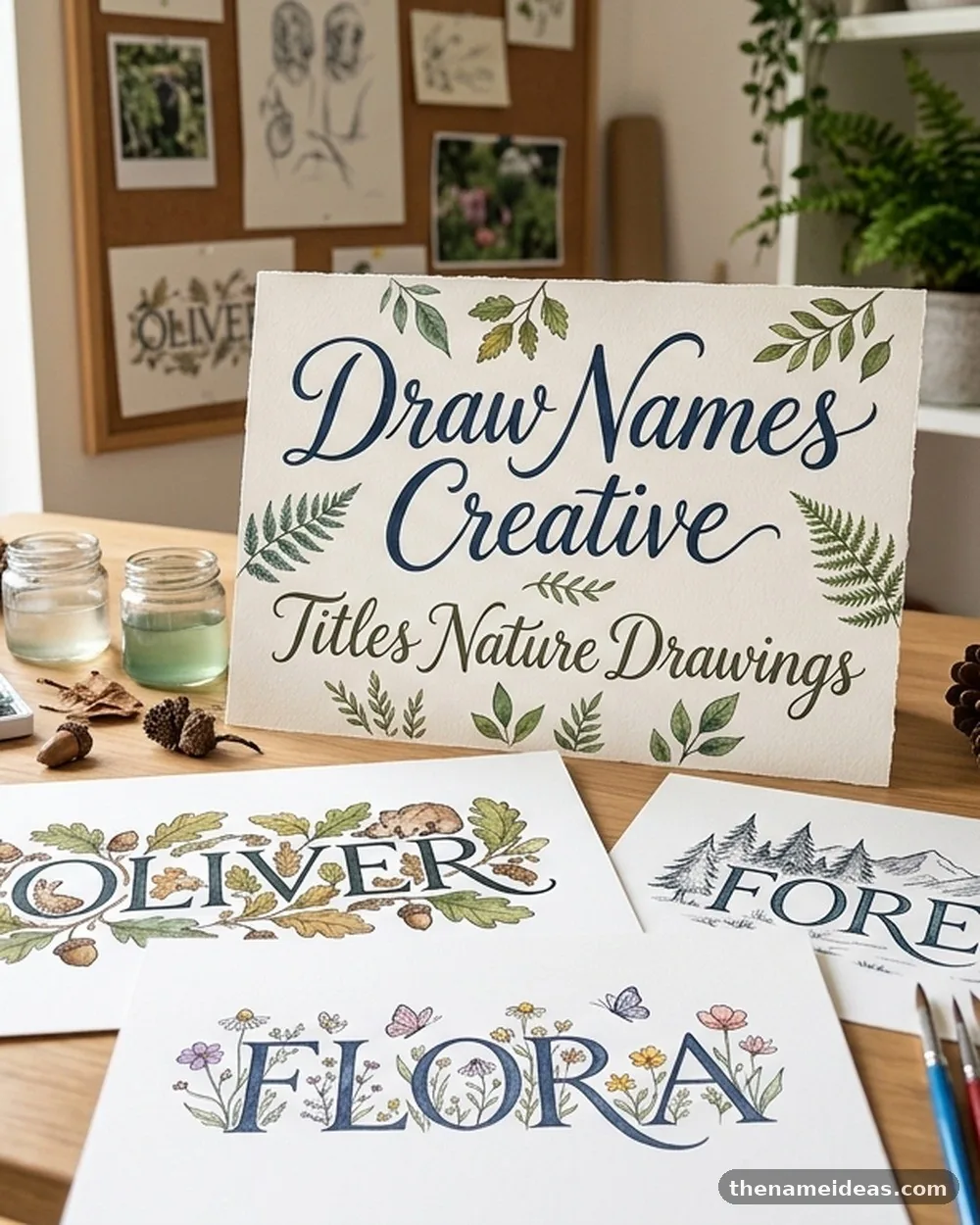
Nature artwork benefits from names that focus on atmosphere rather than simply repeating the subject. A drawing of trees does not have to be called “Trees”; it could become “The Woodland Keeps Its Secret” or “Green After Rain.”
- Meadow After Thunder
- Roots Beneath the Glass
- Golden Hour Orchard
- Wind Across the Reeds
- Foxglove on the Hill
- Rain in the Ferns
- Where the Pines Lean
- Winter’s Quiet Edge
- Seed, Soil, Sky
- Moonlit Tidelands
Titles for People and Portraits
Portrait titles can emphasize identity, expression, clothing, location, or the relationship between the subject and the artist. If the person is not named publicly, a symbolic title can protect privacy while giving the artwork character.
- Eyes on the Horizon
- The Blue Scarf
- Portrait in Soft Weather
- Her Sunday Light
- Stillness with Open Hands
- The Boy Who Counted Stars
- Face of the Afternoon
- Waiting by the Window
- Borrowed Confidence
- A Smile Between Moments
Funny and Playful Draw Name Ideas
Funny names work especially well for casual gift exchanges, office activities, family games, and friend groups. They lower the pressure and make the event feel more social, but the joke should be understandable to everyone involved rather than aimed at one person.
- The Great Gift Shuffle
- Operation Secret Socks
- Who Bought This?
- The Mystery Present Club
- Santa’s Spreadsheet
- Wrap Battle
- The Sneaky Stocking Society
- Guess Your Gifter
- Box, Bow, and Confusion
- The Present Situation
- Secret Santa, Loud Packaging
- The Gift Goblin Draw
- Unwrap at Your Own Risk
- The Merry Mismatch
- Operation Nice-ish
A playful title is better than an intimidating one when the group includes children, relatives, new colleagues, or people who do not know one another well. Humor gives the activity a welcoming tone and can make a simple name draw feel like an event.
Use care with inside jokes. A reference that makes sense to three close friends may confuse a larger group, especially if names are being drawn anonymously. Keep the joke focused on the activity, not on someone’s appearance, income, age, beliefs, or personal life.
Funny Names for Friends and Families
Friends can usually handle more informal wording, while family events often benefit from names that work across generations. These examples are light enough for a group chat, invitation, or printed card.
- Cousins, Cash, and Chaos
- The Family Gift Relay
- Wrapped and Slightly Worried
- Grandma Knows Everything
- The Leftover Budget Club
- Friends Who Forgot the Rules
- The Cheerful Guessing Game
- Present Day Problems
- One Name, One Surprise
- The Tinsel Committee
Cute, Seasonal, and Aesthetic Ideas
Cute names suit children’s activities, classroom exchanges, close friend groups, and holiday events with a gentle atmosphere. They often use warm imagery—stars, ribbons, snow, cookies, bells, or little houses—without sounding too formal.
- Little Lights Gift Draw
- Snowflake Surprise
- Cozy Wish Circle
- Ribbon and Starlight
- Warm Wishes Workshop
- The Gingerbread Guess
- Moonbeam Mail
- Holly and Honey
- Sweet Swap Sunday
- Winter Window Wishes
- Marshmallow Morning
- The Tiny Treasure Draw
- Berry Bright Exchange
- Candlelight Wishes
- Little Bells, Big Surprises
Aesthetic names tend to be quieter and more polished. They are useful for art collections, social posts, handmade gift projects, or an event that wants a calm visual identity instead of a loud Christmas theme.
- Velvet December
- Soft Gold Exchange
- Winter in Ink
- Ivory and Evergreen
- Paper Lantern Wishes
- Quiet December Club
- Amber Ribbon
- Frosted Letterbox
- Silver Pine Gathering
- Sunday Snowfall
Seasonal names should not assume that every participant celebrates Christmas. If the group includes people with different traditions, phrases such as “winter exchange,” “warm wishes,” or “year-end gift draw” can be more inclusive.
Creative Ways to Draw Names for Gifts and Prizes
The simplest method is to write each participant’s name on an identical slip of paper, fold the slips the same way, and place them in a container. One person mixes them thoroughly while another person draws, or each participant draws one slip in turn.
For a Secret Santa arrangement, the process needs one extra rule: nobody should draw their own name. If that happens, the group can return the slip and redraw, or use a prepared assignment system that prevents self-matches from the beginning.
- Confirm the final participant list before creating the draw.
- Ask whether anyone has a restriction, such as not drawing a partner or household member.
- Set the spending limit, exchange date, and gift expectations in advance.
- Write names clearly and use identical pieces of paper.
- Explain how redraws, missed participants, and late entries will be handled.
- Keep a private record of assignments if someone needs help later.
For a prize draw, transparency is more important than theatrics. Give every eligible person one entry unless the rules clearly allow multiple entries, and state the closing time before selecting the winner.
An online name picker can be useful when people live in different places. A neutral randomization service such as the RANDOM.ORG list randomizer may help with a basic list, but the organizer should still protect private information and explain the process to the group.
Ideas for Making a Physical Draw More Fun
- Place names inside folded paper stars or small envelopes.
- Hide each name beneath a numbered cup or card.
- Use a seasonal bowl decorated by the group.
- Let each person draw after answering a harmless trivia question.
- Put the names in small gift bags for a visual surprise.
- Use colored cards to separate adults, children, or prize categories.
The decoration should support the activity rather than slow it down. If people are waiting to find out their assignments, a complicated reveal can become frustrating quickly.
Gift Exchange Names for Different Groups
The best name depends partly on the people involved. A workplace exchange needs clarity and restraint, while a close group of friends may prefer a joke or a reference that reflects shared history.
| Group | Suitable tone | Example names |
|---|---|---|
| Office colleagues | Friendly and professional | Team Cheer Exchange; December Draw |
| Close friends | Playful and informal | Wrap Battle; The Present Situation |
| Family | Warm and inclusive | Cousins, Cash, and Chaos; Cozy Wish Circle |
| Classroom | Simple and child-friendly | Kindness Card Draw; Little Lights Exchange |
| Online community | Clear and easy to type | Winter Wish Drop; Digital Gift Circle |
For an office, avoid names that imply a required religious celebration or a particular spending level. “Year-End Surprise Exchange” is often safer than a heavily themed name if the group has varied backgrounds.
A classroom activity should make the rules obvious. “Mystery Gift Draw” tells children what will happen, while a highly abstract title may be attractive to adults but confusing to younger participants.
Online communities need names that display well in chat channels, event pages, and mobile notifications. Keep the wording short, avoid unusual punctuation, and make sure the title can be pronounced naturally during a voice call.
How to Create More Distinctive Names
Original names usually come from combining two specific ideas rather than stacking generic adjectives. Start with the purpose, then add an image, mood, place, object, or action that gives the phrase a particular identity.
- Purpose plus image: Gift Lantern, Prize Orchard, Wish Table.
- Season plus action: Winter Unwrapped, Springtime Shuffle.
- Object plus mood: Velvet Envelope, Restless Ribbon.
- Place plus event: Fireside Draw, Corner-Shop Surprise.
- Verb plus symbol: Gather the Stars, Pass the Parcel.
Specific nouns are more useful than broad words such as “fun,” “awesome,” or “special.” “Lantern” creates a picture. “Awesome” does not tell the reader anything about the event.
Sound also affects memorability. Alliteration can help—“Ribbon Roundup” is easy to say—but too much repetition can make a title feel childish. Two or three words with different sounds often produce a cleaner result, such as “Midnight Parcel” or “Golden Guess.”
A Simple Naming Formula
Try this process when you need to make a name from scratch. First, write five words connected to the event.
Next, write five words describing the feeling you want. Finally, pair ideas from both columns and remove combinations that sound forced.
For example, a family gift exchange might produce “cousins,” “kitchen,” “winter,” “surprise,” and “cards” in the first group. The mood list might include “warm,” “funny,” “cozy,” “secret,” and “bright.” Possible results include “Kitchen Surprise,” “Bright Card Draw,” and “Cozy Cousins Exchange.”
Read every candidate aloud. If people stumble over it, cannot spell it, or need an explanation before understanding it, simplify the wording.
What Makes a Name Memorable?
A memorable name has a clear shape in the mind. It may use an unusual image, a pleasing rhythm, a small surprise, or a direct connection to the event. It does not need to be long or complicated.
Contrast helps. “Quiet Riot” works because the two words pull in different directions, while “Happy Fun Surprise” gives the reader three similar levels of meaning and little visual detail.
Names are also easier to remember when they fit the experience. A formal title for a chaotic friend exchange may feel unnatural, and a silly title for an awards ceremony may weaken the event’s tone.
| Quality | What it does | Example |
|---|---|---|
| Clarity | Explains the activity quickly | Family Gift Draw |
| Imagery | Creates a picture or mood | Lantern Wishes |
| Rhythm | Makes the phrase easy to say | Wrap, Wish, Win |
| Specificity | Separates the idea from generic titles | Fireside Parcel Club |
| Audience fit | Matches the group’s age and culture | Classroom Kindness Draw |
Try writing the name in the places where people will actually see it: a group message, invitation, spreadsheet, printed sign, or social post. A name that looks elegant on a poster may be too long for a chat title.
Spelling matters, too. If a name contains an unusual word, decide whether the added originality is worth the explanation. In many cases, a familiar word arranged in an unexpected way is more effective than an obscure word nobody can remember.
Common Mistakes When Drawing Names
The first mistake is beginning the draw before the participant list is final. A late addition can disrupt assignments, especially if the group has rules against couples, people from the same household, or last year’s match repeating.
The second is failing to communicate the practical details. Participants should know the date, budget, gift expectations, and whether handmade or secondhand gifts are acceptable before names are assigned.
- Do not leave unclear names in the container if two people have similar names.
- Do not assume everyone has the same budget or shopping access.
- Do not publish Secret Santa assignments in a group chat.
- Do not use a joke that embarrasses a specific participant.
- Do not add names after the draw without explaining the change.
- Do not collect unnecessary personal information for an online exchange.
Another problem is choosing a title that promises more than the activity provides. “Grand Holiday Celebration” sounds like a complete event, not a simple name draw, and could create the wrong expectation.
For artwork, avoid titles that describe a completely different subject. A clever phrase cannot rescue a title that confuses the viewer about the drawing’s central idea. Use symbolism, but keep one visible connection to the work.
Finally, check whether the chosen phrase has an unintended meaning in another language, workplace context, or age group. A quick conversation with two or three people can reveal an awkward interpretation before the name appears on invitations or gifts.
FAQ About Draw Names
What are some creative drawing names I can use?
For artwork, try titles such as “Quiet Lines at Dusk,” “Paper Moon Garden,” “The Shape of Waiting,” “Rain in the Ferns,” or “Portrait in Soft Weather.” Choose a title based on the drawing’s mood, strongest image, color palette, or implied story rather than adding a random decorative phrase.
How can I draw names fairly for a Secret Santa exchange?
Confirm the participant list first, write every name clearly, and use identical folded slips or a transparent random method. Decide in advance how you will handle self-draws, couples, household members, late entries, and a person who leaves the group.
Should a draw name be funny or formal?
Match the tone to the audience and purpose. A funny name suits close friends and casual family events, while a neutral title is usually better for a workplace, school, charity, or mixed community group.
Can I draw names online?
Yes, an online method can help distributed groups, but the organizer should explain the rules and limit the personal information collected. Check the result privately, provide clear instructions for wish lists or gifts, and avoid posting confidential assignments where everyone can see them.
What should I name a drawing if I do not know where to start?
List the drawing’s subject, setting, colors, emotion, and most noticeable detail. Combine one concrete word with one mood word, such as “Copper Morning,” “Restless Garden,” or “Blue Room,” then say the options aloud and choose the one that feels most connected to the work.
Final Thoughts on Draw Names
The strongest draw names are clear enough to understand and distinctive enough to remember. For gift exchanges, focus on fairness, privacy, and the group’s personality; for artwork, use the title to suggest mood, story, or visual detail without explaining everything.
Whether you are organizing a family Secret Santa, choosing a prize winner, or naming a new drawing, test the phrase in its real setting before committing to it. A little attention to audience, sound, spelling, and purpose will make Draw Names feel more personal, organized, and enjoyable.