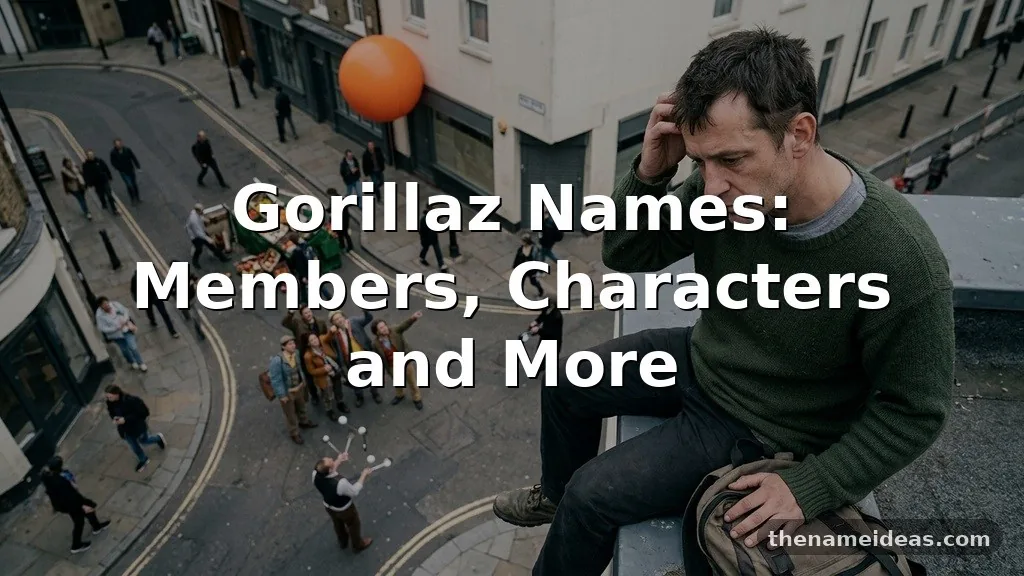
Gorillaz names can mean two different things: the fictional characters who form the cartoon band, and the real musicians who create its music. The core characters are 2-D, Murdoc Niccals, Noodle and Russel Hobbs, while Damon Albarn and Jamie Hewlett built the project behind the scenes.
Their identities, histories and changing roles have developed across albums, music videos, live shows and animated stories. This guide explains who each character is, where the names came from, which temporary members appeared, and what is actually known about questions surrounding the band’s relationships and identities.
The Four Core Gorillaz Names
When people ask for the Gorillaz members in order, they usually mean the four fictional figures who make up the central lineup. They are not simply animated versions of the musicians: each has an independent biography, personality, visual design and role in the band’s mythology.
| Character name | Full or associated name | Main role | First-era identity |
|---|---|---|---|
| 2-D | Stuart “2-D” Pot | Lead vocals, keyboards | Blue-haired frontman |
| Murdoc Niccals | Murdoc Alphonce Niccals | Bass guitar, band founder within the fiction | Green-skinned bassist |
| Noodle | Noodle | Guitar, keyboards, vocals | Young Japanese guitarist |
| Russel Hobbs | Russel Hobbs | Drums and percussion | American drummer |
There is an important distinction between the fictional lineup and the people heard on a Gorillaz recording. Albarn is the principal musical force associated with the project, while Hewlett created the distinctive artwork and character designs. Guest vocalists, instrumentalists and producers can appear on individual songs without becoming permanent members of the cartoon group.
The lineup has also changed temporarily inside the story. That is why a video, album campaign or live presentation may feature a different figure without replacing the four names most listeners recognize.
2-D: The Voice and Face of the Band
2-D is the character most often placed at the front of Gorillaz. His name is commonly expanded to Stuart Pot, and the nickname refers to the two dents in his forehead. He is known for his tall, thin frame, bright blue hair, black eyes and missing or damaged teeth.
Within the fictional backstory, Stuart worked at a music shop before meeting Murdoc. A car accident caused one of the injuries associated with his appearance, and a later incident produced the second indentation that inspired “2-D.” The character’s repeated misfortune is part of the band’s darkly comic storytelling rather than a realistic biography.
2-D’s musical role is lead singer and keyboard player. His soft, often melancholy vocal presence helps define songs such as “Tomorrow Comes Today,” “Feel Good Inc.” and “On Melancholy Hill,” although the real recordings involve Albarn and a wide range of collaborators.
His personality is usually presented as passive, dreamy and easily distracted. That makes him a useful contrast to Murdoc, whose confidence and manipulation drive much of the fictional plot. 2-D may be the public face of the group, but he is rarely the person controlling its direction.
Why the name 2-D matters
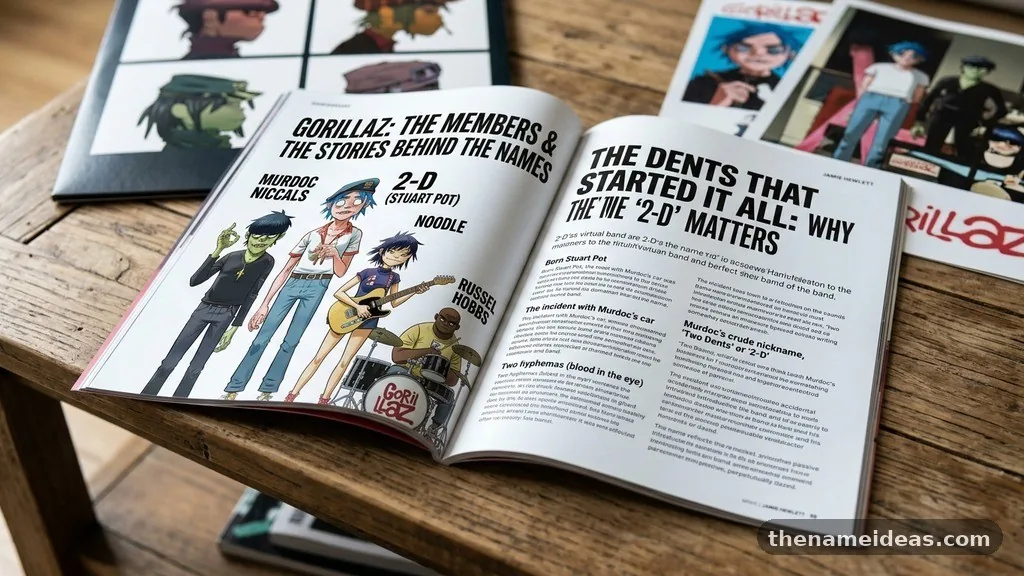
The name is a visual joke that became a character identity. “Two dents” gives the nickname a direct connection to his appearance, while “Stuart Pot” makes him sound like an ordinary person caught inside an extraordinary cartoon narrative.
That contrast is central to Gorillaz. The band combines realistic details, absurd violence, supernatural events and music-industry satire, so a simple nickname can function as both a physical description and a memorable stage name.
Murdoc Niccals: Bassist, Founder and Antagonist
Murdoc Niccals is the green-skinned bassist and one of the most recognizable Gorillaz names. His full name is generally given as Murdoc Alphonce Niccals. He has a pointed nose, black hair, heavy eye makeup and a theatrical appearance that matches his role as the group’s self-appointed leader.
Murdoc’s fictional personality is arrogant, manipulative and fond of occult imagery. He presents himself as a dangerous rock star, but the stories often undercut that image with slapstick, failure and insecurity. He is written as both a villainous influence and a comic character.
In the band’s backstory, Murdoc encounters Stuart Pot and eventually forms the group around him. The relationship between the two is frequently hostile. Murdoc wants control, while 2-D is repeatedly pulled into situations he did not choose.
Murdoc’s bass playing gives the fictional band its low-end foundation, but his role extends beyond music. He frequently acts as spokesman, schemer and unreliable narrator during interviews, online campaigns and animated episodes.
Murdoc across the album eras
Murdoc’s story changes from one album cycle to the next. During the early Gorillaz and Demon Days period, he is closely tied to Kong Studios, the band’s fictional headquarters. Later campaigns move the characters through prisons, yachts, deserts, studios and other exaggerated locations.
For the Humanz era, Murdoc’s absence from the group’s central setting becomes part of the story. In the period surrounding The Now Now, he is imprisoned and replaced temporarily by Ace. These shifts let Gorillaz change its visual focus without abandoning the established character universe.
Noodle: Guitarist, Inventor and Cultural Icon
Noodle is the guitarist of Gorillaz and the only female member of the core quartet. She arrived at Kong Studios in a shipping crate as a child, according to the fictional story surrounding the first album era. The deliberately mysterious introduction made her origin part of the band’s early mythology.
Her name is simply Noodle, although the character has been given additional backstory and identities over time. Unlike a conventional biography, her history has been revised and expanded through videos, website material, interviews and album campaigns.
Noodle is usually portrayed as highly skilled, intelligent and adaptable. Her musical role includes guitar, keyboards and occasional vocals. She is also associated with martial arts, language skills, engineering and an ability to handle situations that overwhelm the other members.
The visual design of Noodle has changed significantly across the years. She appears as a young child in the early videos, grows into a teenager during later campaigns, and takes on more mature designs in eras such as Plastic Beach, Humanz and Cracker Island.
Noodle’s role in the group
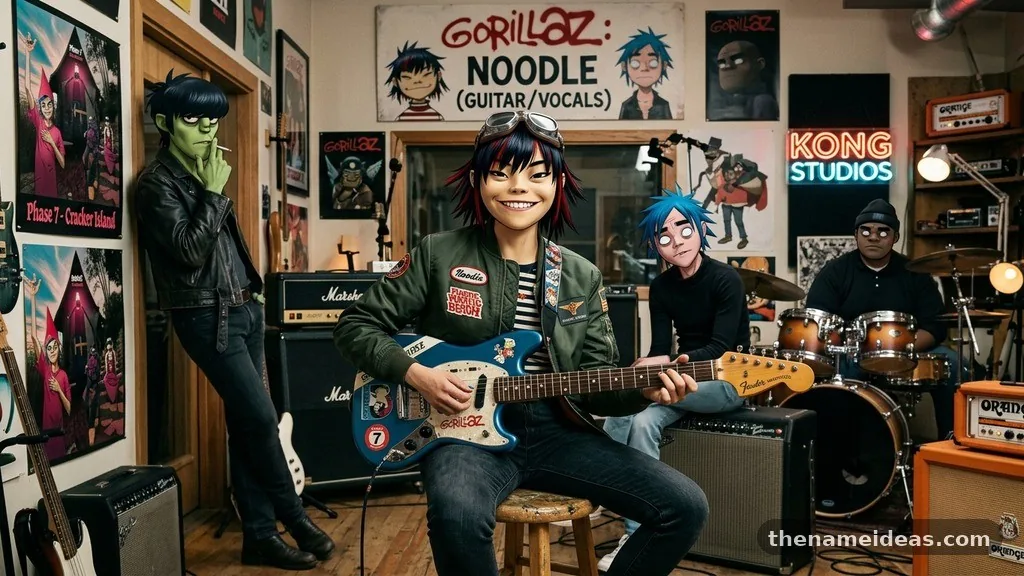
Noodle is more than a guitarist added for visual variety. She often serves as the band’s practical problem-solver, balancing 2-D’s passivity and Murdoc’s recklessness. Her competence gives the fictional lineup a different kind of energy from the usual frontman-and-bassist conflict.
Her Japanese identity is part of the character’s established presentation, but it should not be treated as a complete explanation of her personality. Noodle’s appeal comes from the combination of musicianship, mystery, humor and changing visual representation.
Russel Hobbs: Drummer and Spiritual Center
Russel Hobbs is Gorillaz’s drummer and percussionist. He is an American character from Brooklyn, New York, and his backstory is more explicitly connected to grief, violence and spirituality than those of the other members.
Russel is described as having fallen into a coma after being possessed by the ghost of his friend Del. That supernatural element becomes one of the defining features of the early Gorillaz story. It also explains why Russel’s eyes and behavior sometimes appear different in the videos.
His musical identity is built around drumming and hip-hop culture. Russel is frequently shown as thoughtful, physically imposing and more grounded than Murdoc or 2-D. The character’s size and calm manner create a visual contrast with Noodle and the narrow, anxious shape of 2-D.
Russel’s character also connects Gorillaz to a wider cast of rappers and guest performers. Del the Ghost Rapper, for example, is a fictional presence linked to Russel and appears in the story around “Clint Eastwood” and related early material.
What Russel adds to the mythology
Russel gives the band’s fictional world a serious emotional layer. His story involves the loss of friends, the danger of street violence and the possibility that music can carry memories across different states of existence.
That does not mean every song narrated by or associated with Russel is literally part of his biography. Gorillaz regularly mixes character fiction with guest performances and visual symbolism. Russel’s backstory is best understood as one strand of a larger multimedia story.
Other Gorillaz Character Names
The four core members are not the only named figures connected with Gorillaz. Some characters are former members, temporary replacements, fictional performers or recurring people from the band’s wider universe.
- Ace — A temporary bassist who replaces Murdoc during the period associated with The Now Now. The character comes from The Powerpuff Girls and appears through a crossover arrangement rather than as one of the original four.
- Paula Cracker — A former guitarist connected to Murdoc and an early version of the group’s story. She predates Noodle in the fictional lineup.
- Del the Ghost Rapper — A supernatural figure associated with Russel and the vocal performance on “Clint Eastwood.”
- Cyborg Noodle — A robotic or artificial version of Noodle introduced during the Plastic Beach period after the original Noodle’s disappearance.
- The Boogeyman — A mysterious figure tied to the darker supernatural side of Gorillaz storytelling, particularly around Murdoc’s occult interests.
- Bootie Brown’s fictionalized appearances — Guest performers can be represented through the band’s cartoon world, although they are not automatically permanent Gorillaz members.
- Sun Moon Stars — A group of fictional figures associated with later promotional and narrative material around the band’s expanded universe.
These names do not all have equal status. Ace is a recognizable temporary replacement, while Cyborg Noodle is a story device connected to one particular album era. Guest performers may appear in videos or illustrated scenes without changing the official core lineup.
The band’s cartoon universe has never operated like a single, uninterrupted television series. It has been spread across videos, websites, interviews, music releases, live visuals and short animated pieces. As a result, details can be playful, contradictory or intentionally incomplete.
Gorillaz Names in Album and Video Order
One useful way to understand the characters is to follow the band’s major album eras. The story does not progress like a strict novel, but each release gives the characters a different setting and visual identity.
| Era | Release | Character focus | Notable context |
|---|---|---|---|
| Early era | Gorillaz (2001) | 2-D, Murdoc, Noodle and Russel | Kong Studios and the band’s origin story |
| Breakthrough era | Demon Days (2005) | The full quartet and wider guest world | Videos such as “Feel Good Inc.” and “Dare” |
| Island era | Plastic Beach (2010) | Murdoc, Cyborg Noodle and a scattered lineup | A floating artificial island and ecological imagery |
| Improvised era | The Fall (2010) | 2-D on a journey through the United States | Recorded during the Escape to Plastic Beach tour |
| Return era | Humanz (2017) | The group under pressure and separated | Large ensemble of guest vocalists |
| Now Now era | The Now Now (2018) | 2-D, with Murdoc replaced by Ace | A more focused and introspective visual campaign |
| Song Machine era | Song Machine, Season One (2020) | The established characters with rotating guests | Episodic releases built around individual songs |
| Island return | Cracker Island (2023) | The quartet in a new cult-like setting | California, celebrity culture and spiritual satire |
The first album established the core visual vocabulary: Kong Studios, music videos as short cartoons and four characters whose personal conflicts could carry a larger story. Demon Days expanded that formula with a bigger cast and a more cinematic tone.
Plastic Beach changed the environment completely. Murdoc’s artificial island, the disappearance of Noodle and the presence of Cyborg Noodle made the band feel less like a studio act and more like a science-fiction narrative.
Later projects became looser. Song Machine was structured as a sequence of episodes, allowing different collaborators and settings to appear without requiring one continuous plot. Cracker Island returned to a more concentrated story involving the core characters and a surreal social group in California.
The Real People Behind the Cartoon Band
Gorillaz is a virtual band, but its music is made by real people. Damon Albarn is the principal co-creator and the musician most closely associated with the project’s songwriting, production and vocals. Jamie Hewlett is the co-creator responsible for the character designs and much of the visual identity.
Albarn’s role does not mean that every sound on a Gorillaz album is performed by him alone. The project regularly uses rappers, singers, instrumentalists, producers and arrangers from different musical backgrounds. That collaborative approach is why one album can move from alternative rock to hip-hop, dub, electronic music, soul or Afrobeat influences.
Hewlett’s contribution is equally important to the names readers recognize. His illustrations made 2-D, Murdoc, Noodle and Russel immediately distinguishable, and the characters could continue appearing in videos even when different musicians handled individual parts of a recording.
The separation between character and performer is deliberate. Gorillaz can present a cartoon bassist, a real bass player, a guest rapper and an animated video scene as parts of one creative object without claiming they are literally the same person.
For a reliable overview of the project’s official presentation, readers can consult the official Gorillaz website. It is useful to compare that material with album credits, because promotional fiction and recording credits answer different questions.
Why the distinction matters
Searches for “Gorillaz members” often mix the fictional quartet with the real musicians. Both interpretations are reasonable, but they should not be collapsed into one list.
If the question is about the cartoon characters, the answer is 2-D, Murdoc Niccals, Noodle and Russel Hobbs. If the question is about the real creators, Damon Albarn and Jamie Hewlett are the essential names, joined by a changing network of collaborators.
Do the Gorillaz Characters Have Names?
Yes. The central characters have established names, roles and backstories. The most important are 2-D, whose personal name is Stuart Pot; Murdoc Niccals; Noodle; and Russel Hobbs.
The use of nicknames is part of the band’s design. 2-D sounds like a stage name, Murdoc’s surname reinforces his exaggerated persona, and Noodle’s single-word name keeps her origin deliberately mysterious. Russel’s straightforward name makes him feel more grounded than the others.
Some supporting figures also have names, but not every person seen in a Gorillaz video is a major character. A dancer, guest singer, animated celebrity or background figure may serve the scene without having a detailed biography.
Are the characters in a fixed order?
There is no universally required order beyond the usual listing of the core quartet. Fans often write them as 2-D, Murdoc, Noodle and Russel, partly because that order reflects the band’s early public presentation.
Other orders can make sense. Someone discussing instruments might begin with 2-D as vocalist, then list Noodle, Murdoc and Russel by musical role. Someone discussing the story might start with Murdoc because he is the fictional founder and main instigator.
Relationships, Identity and the LGBT Question
Questions about sexuality and relationships appear frequently in discussions of Gorillaz characters. The safest answer is that the band’s fictional universe uses ambiguity, flirtation, rivalry and subtext more freely than it provides formal identity labels.
Murdoc and 2-D have a famously hostile, dependent relationship, but it should not automatically be described as a confirmed romantic relationship. Their interactions can be read through rivalry, exploitation, friendship, abuse, comedy or queer subtext depending on the scene and the audience.
Noodle is a female character, but the official character story does not provide a simple universal answer that defines her sexuality. Fan interpretations are not the same as a confirmed statement from the creators.
Russel’s stories focus more heavily on music, loss, spirituality and friendship. The presence of Del the Ghost Rapper and other supernatural elements adds narrative complexity, but it does not by itself establish a sexual identity for Russel.
Gorillaz has always benefited from leaving parts of its characters open to interpretation. That openness allows listeners to form personal connections, but it also means that claims presented as definite canon should be checked carefully against official material rather than repeated from fan discussions.
Why the Names Remain Memorable
The Gorillaz names work because each one is short, visually distinctive and easy to attach to a silhouette. “2-D” suggests the character’s appearance, “Noodle” is unusual enough to be instantly recognizable, “Murdoc Niccals” sounds theatrical, and “Russel Hobbs” feels ordinary in comparison.
The names also support strong separation between characters. Their hairstyles, body shapes, colors, instruments and personalities reinforce the words, so a viewer can often identify someone before hearing dialogue.
- 2-D uses a compact nickname with a visual explanation.
- Murdoc Niccals combines a memorable first name with a surname that suits his exaggerated persona.
- Noodle uses a single unusual word that creates immediate curiosity.
- Russel Hobbs sounds comparatively realistic, giving the quartet a grounded contrast.
The names are also flexible across different media. They work in album credits, music videos, animated episodes, interviews, toys, posters and live visuals. A strong fictional name must survive all of those contexts without becoming difficult to pronounce or explain.
That is one reason the band’s naming remains effective after many years. The names are not merely labels attached to cartoon drawings; they are part of a repeatable identity system that lets each new album introduce a fresh setting while keeping the audience oriented.
Frequently Asked Questions About Gorillaz Names
Who are the four members of Gorillaz?
The four core fictional members are 2-D, Murdoc Niccals, Noodle and Russel Hobbs. Their roles are lead vocals and keyboards, bass, guitar and keyboards, and drums and percussion respectively.
What is 2-D’s real name?
2-D’s personal name is generally given as Stuart Pot. The nickname refers to the two dents in his forehead, which are part of his fictional backstory and character design.
Is Ace an original Gorillaz member?
No. Ace is a temporary replacement for Murdoc during the period associated with The Now Now. He is not one of the original four core members.
Who created Gorillaz?
Damon Albarn and Jamie Hewlett created Gorillaz. Albarn is associated primarily with the music, while Hewlett created the visual designs and animated character world.
Are Gorillaz characters real people?
No. The characters are fictional animated figures, although real musicians provide the voices, instruments and production behind the recordings. The project intentionally presents those two layers together.
Final Take on Gorillaz Names
The most important Gorillaz names are 2-D, Murdoc Niccals, Noodle and Russel Hobbs, with Ace, Paula Cracker, Cyborg Noodle and Del adding depth to the wider story. Remember that the fictional quartet and the real creative team are separate parts of the same project: Albarn drives much of the music, while Hewlett shaped the cartoon world that made the characters famous.
That separation is the key to understanding Gorillaz names without confusion. Start with the four core characters, then place supporting figures and real collaborators in the album era where they belong. If a detail concerns romance, identity or a complicated episode of the mythology, treat it carefully and distinguish confirmed story material from fan interpretation.


1 thought on “Gorillaz Names: Members, Characters and More”