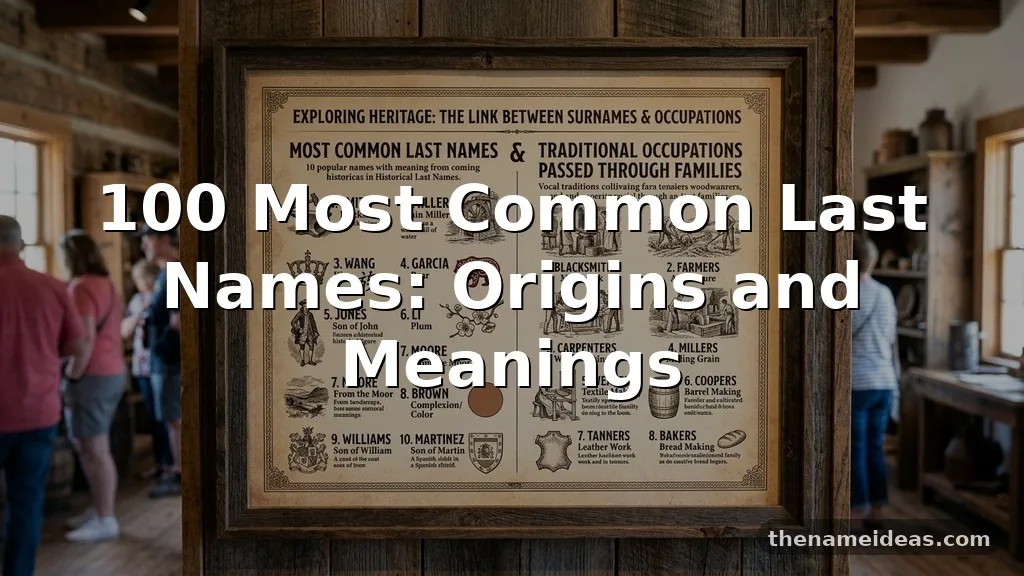
The most common last names reveal how families were identified across languages, occupations, places, and generations. A surname such as Smith may point to an ancestral trade, while names such as García, Nguyen, or Patel reflect regional naming traditions and enormous family networks.
There is no single official ranking of the world’s surnames because countries record names differently, spellings change through migration, and some cultures use patronymic systems. The collection below brings together widely encountered common surnames, explains the traditions behind them, and shows how they can work in family research, writing, usernames, or a gaming clan identity.
How to Read a Global Surname List
A list of the 100 most common last names in the world cannot be treated like a definitive census table. China, India, Indonesia, Nigeria, Brazil, the United States, and European countries collect population data in different ways, while romanization can make one surname appear under several spellings.
For example, the Chinese surname 王 may be written as Wang in Mandarin-based systems, but older records may use another romanization. Similarly, García and Garcia refer to the same surname in many records, while names such as De Vries, de Vries, and DeVries may be sorted differently by databases.
For a country-specific ranking, an official population source is more reliable than a global list. The U.S. Census surname data, for example, offers a useful reference for names recorded in the United States, but it does not represent every country or every naming tradition.
| Naming tradition | Common pattern | Examples |
|---|---|---|
| Occupational | Ancestor’s trade or role | Smith, Baker, Cooper |
| Patronymic | Descent from a parent or ancestor | Johnson, Wilson, Hansen |
| Locational | Place, landscape, or settlement | Dubois, Murray, Silva |
| Clan or family-based | Lineage, kinship, or inherited house name | Campbell, Cohen, Patel |
| Romanized Asian surnames | One original character or syllable may have several spellings | Wang, Li, Nguyen |
English Occupational and Trade Surnames
Many English surnames began as practical labels. In a village where several men shared the same first name, calling one person “the smith” or “the baker” helped distinguish him from his neighbors. Over time, the description became hereditary even when later descendants had completely different occupations.
Occupations Passed Through Families
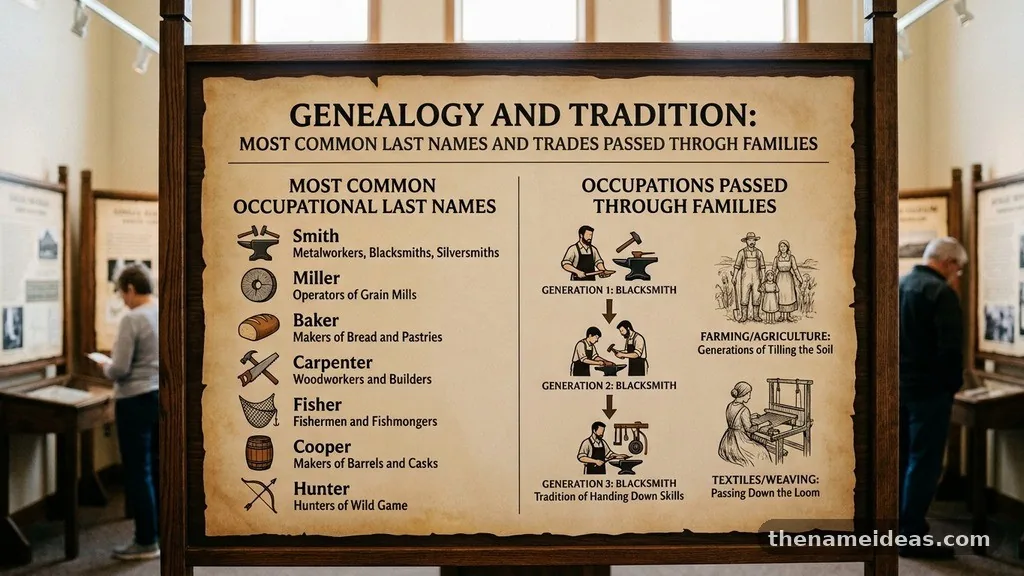
- Smith — associated with a metalworker, blacksmith, or other smithing trade.
- Baker — linked to the person who made or sold bread.
- Cooper — traditionally referred to a maker of wooden barrels and casks.
- Carter — connected with someone who transported goods by cart.
- Turner — often associated with a craftsperson who shaped wood or metal on a lathe.
Smith remains one of the clearest examples of an English occupational surname. Its frequency is not proof that all people with the name share one recent family line; the name could have developed independently in many towns.
Craft, Work, and Daily Life
Occupational surnames are useful reminders that medieval communities often identified people by what they did. The same pattern appears in many languages, although the spelling and pronunciation change across regions.
- Wright — associated with a maker or builder, especially a craft worker.
- Taylor — derived from the occupation of tailoring clothing.
- Fisher — connected with fishing or a person who worked near fisheries.
- Cook — linked to a household, inn, or professional kitchen worker.
- Miller — associated with operating a mill, commonly for grain.
These names can also inspire believable fictional characters because their meanings are easy to understand. A character named Miller may have no connection to a mill today, just as a gaming group using “The Millers” would not necessarily be making a historical claim.
English Patronymic and Place-Based Surnames
Another major group of English last names developed from a parent’s first name, a physical location, or a recognizable feature of the landscape. The suffix “-son” often signals “son of,” although inherited surnames eventually stopped changing with every generation.
Names Built From Family Descent
- Johnson — traditionally interpreted as “son of John.”
- Wilson — generally connected with “son of William.”
- Jackson — commonly understood as “son of Jack.”
- Harrison — associated with “son of Harry” or Henry.
- Robinson — linked to “son of Robin,” a form of Robert.
Patronymic names are common across Europe and beyond. Comparable structures appear in Scandinavian, Slavic, Irish, Scottish, and South Asian naming systems, although some cultures preserve the parent-based element more actively than others.
Landscape and Settlement Names
- Brown — may have described hair color, complexion, clothing, or another visible trait.
- Green — often connected with living near a village green or grassy area.
- Hill — could identify someone who lived near or on a hill.
- Wood — generally associated with residence near woodland.
- White — may have referred to appearance, hair color, or clothing.
Simple landscape surnames appear in records across English-speaking countries because the underlying features were common. Their meaning is usually suggestive rather than conclusive; historical documents are needed to establish how a particular family acquired its name.
German, Dutch, and Scandinavian Surnames
German surnames often reflect trades, personal qualities, or family relationships. Scandinavian names traditionally used patronymics, while Dutch surnames frequently developed from places, occupations, nicknames, or particles such as “de” and “van.”
German Occupational Surnames
- Müller — the German form of Miller, associated with a miller.
- Schmidt — linked to a smith or metalworker.
- Schneider — the German word for tailor.
- Fischer — associated with fishing or a fisherman.
- Weber — connected with weaving and textile work.
Accent marks and regional spelling matter in German names. Müller may appear as Mueller in records that do not support the umlaut, while Schmidt and Schmitt can represent related regional forms without proving that two families share one immediate ancestor.
Dutch and Scandinavian Forms
- de Vries — traditionally associated with a Frisian origin.
- Janssen — commonly connected with “son of Jan.”
- Hansen — generally interpreted as “son of Hans.”
- Nielsen — traditionally means “son of Niels.”
- Andersen — associated with “son of Anders.”
Patronymic surnames such as Hansen, Nielsen, and Andersen became fixed family names in many records only after naming laws or administrative practices changed. That history explains why the same pattern appears so frequently in Denmark, Norway, and neighboring regions.
Irish, Scottish, and Welsh Last Names
Irish, Scottish, and Welsh surnames preserve several naming traditions, including Gaelic personal names, clan associations, patronymics, occupations, and place references. Anglicization also changed spelling, pronunciation, and sometimes the visible meaning of a surname.
Irish Family Names
- Murphy — an Anglicized Irish surname with roots in a Gaelic personal name.
- Kelly — derived from an Irish family name with several historical branches.
- Sullivan — an Anglicized form associated with the Gaelic Ó Súilleabháin.
- O’Brien — a surname using “O,” traditionally indicating descent from a male ancestor.
- Ryan — an Irish surname with several regional and historical forms.
The prefix O does not mean that every person with the surname belongs to one modern organization or single documented household. Irish surnames often developed in multiple places, and migration carried them throughout North America, Australia, Britain, and other regions.
Scottish and Welsh Names
- Campbell — a major Scottish surname with a long clan history.
- Stewart — connected historically with the office of steward and a prominent Scottish royal house.
- Murray — associated with a Scottish regional and family name.
- Davies — commonly understood as a Welsh patronymic meaning “son of David.”
- Evans — a Welsh patronymic associated with Evan, a Welsh form of John.
Clan history can make a surname culturally meaningful, but a shared last name alone does not establish a direct genealogical connection. Family records, geography, and dates still matter.
French and Italian Surnames
French and Italian surnames often draw from personal names, occupations, colors, places, and physical descriptions. Their frequency varies sharply by region, and accents or spelling conventions may change after families move across borders.
Common French Forms
- Martin — derived from the personal name Martin.
- Bernard — developed from a Germanic personal name used in French-speaking areas.
- Dubois — literally associated with “the woods” or a person living near woodland.
- Thomas — based on the biblical and personal name Thomas.
- Robert — derived from a Germanic personal name that became widespread in France.
Martin illustrates why a surname can be common without pointing to one family. A popular medieval given name could generate many independent surnames in different towns.
Common Italian Forms
- Rossi — often linked to reddish hair, complexion, or a nickname.
- Russo — related to a nickname meaning red-haired or reddish in appearance.
- Ferrari — associated historically with a farrier or ironworker.
- Esposito — historically connected with an exposed or abandoned child in certain records.
- Romano — commonly connected with someone from Rome or Roman territory.
Italian surnames often show a regional pattern. A name may be especially frequent in one province while remaining less common elsewhere, so a national list can hide important local differences.
Iberian and Hispanic Surnames
Spanish and Portuguese surnames are widely distributed because of migration, colonial history, and large populations in Europe and the Americas. Hispanic surnames may combine a family name from each parent, and some records preserve compound forms such as García Rodríguez.
Spanish Family Names
- García — one of the most widely encountered Spanish surnames, with an old Iberian history.
- Rodríguez — traditionally interpreted as “son of Rodrigo.”
- Martínez — generally associated with “son of Martín.”
- Hernández — commonly understood as “son of Hernando” or Fernando.
- López — traditionally linked with “son of Lope.”
Names ending in “-ez” often have a patronymic history, although their modern use is hereditary. A person named García Rodríguez may have two inherited surnames rather than a middle name and a last name in the English-speaking sense.
Portuguese Family Names
- Silva — associated with woodland or forest.
- Santos — connected with “saints” or a religious reference.
- Oliveira — associated with an olive tree or olive grove.
- Pereira — traditionally linked with a pear tree or pear orchard.
- Costa — commonly associated with a coast, slope, or hillside.
Portuguese surnames appear throughout Brazil, Portugal, parts of Africa, and immigrant communities around the world. Their geographic spread means that the same surname can have several unrelated family histories.
Chinese, Korean, and Japanese Surnames
Many Asian surnames are short when written in Latin letters, but that does not mean their histories are simple. Romanization systems, regional pronunciation, Chinese characters, and immigration records can all affect how a surname appears.
Chinese Surnames in Romanized Form
- Wang — a highly widespread Chinese surname written with different regional pronunciations.
- Li — a common surname with more than one possible character origin.
- Zhang — traditionally associated with a character connected with drawing or stretching a bow.
- Liu — an old Chinese surname with several historical explanations.
- Chen — connected historically with the ancient state of Chen.
Romanization can make unrelated surnames look similar or make one surname appear different. Genealogists often need the original character, home region, and family records to move beyond a Latin spelling.
Korean and Japanese Surnames
- Kim — a very common Korean surname with multiple historic clan origins.
- Lee — a common English spelling of Korean and Chinese-derived surname forms.
- Park — often written Bak or Pak in other romanization systems.
- Sato — a widespread Japanese surname with several historical interpretations.
- Suzuki — a Japanese surname associated traditionally with a type of grass or agricultural setting.
“Lee” is especially complicated because it can represent different East Asian surnames and may also be an English surname with separate origins. Spelling alone is rarely enough to identify a family line.
South Asian and Southeast Asian Surnames
South Asian last names may reflect caste or community history, occupation, geography, religion, language, or a father’s name. Southeast Asian surnames also vary by national naming customs, and Vietnam’s large surnames can appear frequently in global records because of population size and migration.
South Asian Surnames
- Patel — historically associated with a village headman or landholding role in parts of India.
- Singh — a name meaning “lion,” widely used among Sikh and other South Asian communities.
- Kumar — a personal and family name associated with “prince” or young man.
- Sharma — a surname with Sanskrit roots and strong historical associations in northern India.
- Das — a name found across South Asia with religious and linguistic variations.
There is no single South Asian naming system. A surname may identify a community in one region, function as a personal name in another, or appear alongside a village name and a father’s name.
Vietnamese and Regional Forms
- Nguyen — the most recognizable Vietnamese surname internationally, with several historical explanations.
- Tran — associated with a historic Vietnamese ruling dynasty and a common family name.
- Le — linked with the Lê dynasty and widely used as a Vietnamese surname.
- Pham — a common Vietnamese surname also seen in overseas communities.
- Huynh — a surname with regional pronunciation and spelling variations.
Vietnamese surnames can be difficult to interpret from English-language records because accents are often removed. The same family may appear under a marked and unmarked spelling depending on the document.
Eastern European and Ashkenazi Surnames
Eastern European surnames often preserve Slavic language patterns, while Ashkenazi Jewish surnames developed through several naming periods and administrative systems. Some names describe occupations or places; others reflect personal names or family descriptors.
Slavic Family Names
- Ivanov — commonly associated with Ivan and often interpreted as “of Ivan.”
- Petrov — linked to the personal name Peter.
- Smirnov — traditionally connected with a word suggesting quiet, gentle, or peaceful.
- Popov — associated historically with a priest or cleric.
- Volkov — linked with the word for wolf.
Slavic surnames may change endings according to gender or language. Transliteration from Cyrillic can also produce competing English spellings, which makes international surname counts less precise.
Ashkenazi Jewish Surnames
- Cohen — associated traditionally with the Hebrew term for priest.
- Levy — connected with the Israelite tribe of Levi.
- Goldstein — a German-language surname meaning “gold stone.”
- Rosenberg — a German-language name associated with “rose mountain.”
- Friedman — generally interpreted as “peaceful person” or “man of peace.”
Decorative German-language surnames became common in some Jewish communities during periods when authorities required fixed family names. A surname’s meaning can be interesting without proving when or why a particular branch adopted it.
Turkish, Middle Eastern, and African Surnames
Last names in Turkey, the Middle East, and Africa reflect languages, religion, geography, professions, and modern state naming policies. In many cases, a surname became fixed relatively recently compared with European hereditary names.
Turkish and Regional Names
- Yılmaz — a Turkish name often associated with fearlessness or resilience.
- Kaya — a Turkish surname connected with rock or cliff.
- Demir — associated with iron.
- Özdemir — combines a meaning related to genuine or original iron.
- Çelik — linked with steel.
Turkish surnames often became standardized after the 1934 Surname Law, which required citizens to adopt hereditary family names. Older family history may therefore use personal names, nicknames, titles, or village references instead.
African Family Names
- Mensah — a widely encountered Ghanaian surname, especially among Akan-speaking communities.
- Ndlovu — a southern African surname connected with the word for elephant in Nguni languages.
- Okafor — an Igbo surname found especially among Nigerian families.
- Adeyemi — a Yoruba name associated with a crown or royal dignity.
- Osei — a Ghanaian surname with Akan roots.
African surnames should not be treated as interchangeable labels for whole countries or ethnic groups. Language, local history, colonial records, and naming customs vary substantially from one region to another.
How Common Last Names Work in the United States
The United States has no single naming tradition. English, German, Irish, Scottish, Hispanic, Asian, African, and Indigenous surnames all appear in American records, often alongside spelling changes caused by immigration, transcription, marriage, or administrative standardization.
A U.S. list may rank Johnson, Williams, Jones, Brown, and Davis near the top, while another source focused on a particular state or generation may show a different distribution. The word “common” therefore needs a defined population, date, and counting method.
- Johnson — a patronymic name found across English-speaking records.
- Williams — generally linked with descent from William.
- Jones — traditionally associated with “son of John.”
- Davis — connected with David and especially common in Welsh and American records.
- Thomas — a personal-name surname found in English, Welsh, French, and other traditions.
Family researchers should compare census schedules, birth and marriage certificates, immigration documents, newspapers, and local archives. A surname search is a starting point, not proof of identity or relationship.
Why Surname Meanings Can Be Misleading
Popular surname websites often present a single neat meaning, but many names have competing explanations. A word may have changed pronunciation, been translated into another language, or been recorded by officials unfamiliar with the family’s original language.
Even a correct meaning does not automatically describe a specific ancestor. Someone named Fisher may not have been a fisherman, and someone named Hill may have lived nowhere near a hill by the time the surname became hereditary.
Three Questions to Ask About Any Surname
- Where was the name recorded? Country and region can change the likely explanation.
- When did the spelling appear? A modern spelling may not match the form used by earlier generations.
- What naming system was in use? Patronymic, clan, occupational, and hereditary systems produce different clues.
Accents, hyphens, prefixes, and capitalization can also affect searches. Try several forms, but do not assume that similar spellings represent the same family.
Using Common Surnames for Characters and Clan Names
Common last names are useful in fiction, role-playing, usernames, and gaming communities because they sound familiar without requiring a complicated explanation. A surname can give a character an immediate cultural or social setting, while a group can adapt one into a clan tag or team identity.
For example, a serious esports organization might use a clean surname-based identity such as “House Carter” or “The Silva Line,” while a casual gaming group may prefer a playful phrase built around a familiar name. The result should reflect the group’s culture rather than suggest an ancestry it does not claim.
| Use case | Effective surname approach | What to consider |
|---|---|---|
| Family history | Use the documented spelling and location | Confirm with primary records |
| Fictional character | Match the name to setting and background | Avoid stereotypes based only on a surname |
| Gaming clan | Use a short, readable variation | Check length and platform rules yourself |
| Online community | Choose a name members can say and type easily | Consider searchability and tone |
For a clan tag, short names usually work better than long historical forms. A group could draw on a surname’s sound, meaning, or regional association, then add a distinct word that expresses its gaming style.
How to Choose a Memorable Surname or Team Identity
The strongest name depends on purpose. A historical project may need accuracy, a novel may need atmosphere, and a multiplayer clan needs something teammates can call out quickly during a match.
Match the Name to the Group
- Competitive teams benefit from concise, confident names that look clear on brackets and social profiles.
- Casual friend groups can use humor, inside references, or a surname twist that feels personal.
- Fantasy communities may prefer names with older sounds, noble houses, or mythological associations.
- Professional brands should favor names that remain readable in logos, videos, and announcements.
- Family projects should preserve documented spellings and avoid turning uncertain meanings into facts.
Say the name aloud before adopting it. If members hesitate over pronunciation or cannot remember the spelling after hearing it once, the name may need simplifying.
Make a Name More Distinctive
Start with a familiar surname, then add one precise idea: a place, color, era, animal, craft, or strategic concept. “Rossi” is common; “Rossi Circuit” creates a more recognizable gaming identity without pretending to be a historical family branch.
Check the name in the spaces where it will actually appear. A clan tag, Discord server, username, stream title, and tournament profile may have different character limits or moderation rules, so the group should verify those details directly before committing.
Common Mistakes With Last Names and Clan Names
The most frequent mistake is treating a surname list as a universal ranking. A name can be number one in one country and relatively unusual in another, while a global population estimate may be impossible to calculate consistently.
- Assuming one meaning is definitive: many surnames have disputed or regional origins.
- Ignoring spelling variants: accents, transliteration, and prefixes can change search results.
- Using stereotypes: a surname does not prove a person’s ethnicity, beliefs, personality, or ancestry.
- Choosing an overlong identity: complicated names are harder to type and remember.
- Skipping practical checks: search the name, inspect existing uses, and confirm platform rules before adoption.
- Confusing a clan label with genealogy: a team name inspired by a surname does not establish family membership.
Distinctiveness also matters. Adding random numbers or repeatedly combining the same familiar words rarely creates a strong identity; a clear concept and a natural rhythm usually work better.
Frequently Asked Questions
What is the most common last name in the world?
There is no universally accepted global number-one surname because countries use different censuses, scripts, transliterations, and counting methods. Wang, Li, Zhang, García, and Smith are often cited among the most widespread, but the answer changes according to the population and spelling system being measured.
What are the 20 most common last names in America?
Frequently encountered U.S. surnames include Smith, Johnson, Williams, Brown, Jones, Garcia, Miller, Davis, Rodriguez, Martinez, Hernandez, Lopez, Gonzalez, Wilson, Anderson, Thomas, Taylor, Moore, Jackson, and Martin. Exact order depends on the source and census year.
What is a rare American last name?
A rare American surname is one recorded for very few people in a defined population or area. Rarity can result from an unusual spelling, a small immigrant community, a translated name, or a family name preserved by only one branch.
Why do some last names have several spellings?
Spelling changes commonly arise from migration, translation, accents, handwriting, clerical errors, and different alphabets. Names written in Cyrillic, Chinese characters, Korean script, or accented European languages may have more than one accepted Latin spelling.
Can a common surname prove family connection?
No. Common surnames often developed independently in different places, so a shared name is only a clue. Dates, locations, relatives, civil records, and other evidence are needed to establish a documented relationship.
Conclusion
The 100 most common last names show how families were named through work, ancestry, geography, language, religion, and local history. They are useful starting points for genealogy and character building, but no worldwide list can provide a perfect ranking or a complete explanation for every family.
Use the surname’s region and spelling as clues, then verify important details with reliable records. If you’re adapting one for a username, guild, or gaming clan, keep the final version clear, pronounceable, and suited to the group’s personality. A strong name should sound right before it ever appears on a screen.