
Across the Bible, the Names of God reveal how Scripture describes his character, authority, presence, and relationship with humanity. Each name adds a distinct shade of meaning, from Creator and King to Shepherd, Healer, and Peace.
These names are not merely labels. They come from prayers, promises, visions, historical events, and titles used by biblical writers. The sections below explain major names of God, show where they appear in Scripture, and clarify which names are Hebrew titles, personal names, or descriptions of divine character.
What the Names of God Mean
The Names of God are biblical terms that communicate who God is and how he acts. Some names identify him as the one true God, while others describe his power, holiness, mercy, wisdom, or covenant relationship with his people.
In the Old Testament, many names come from Hebrew words and phrases. For example, Elohim is associated with God as Creator and sovereign ruler, while YHWH, often represented in English as Yahweh or Jehovah, is connected with God’s covenant identity and enduring existence.
Not every expression is a personal name in the same sense. “Rock,” “Shepherd,” “Light,” and “Redeemer” are titles or metaphors, yet they are still important because Scripture repeatedly uses them to reveal God’s character.
English Bibles also vary in how they represent these terms. Some translations use “LORD” in capital letters for the Hebrew divine name YHWH, while others use Yahweh in explanatory notes or certain passages. A reader comparing the KJV, WEB, NIV, and other translations may therefore see different forms of the same underlying term.
| Name or title | Basic meaning | Primary emphasis | Representative reference |
|---|---|---|---|
| Elohim | God, mighty Creator | Power and sovereignty | Genesis 1:1 |
| YHWH | The self-existent covenant God | Faithfulness and identity | Exodus 3:14–15 |
| El Shaddai | God Almighty | Strength and sufficiency | Genesis 17:1 |
| El Elyon | God Most High | Supreme authority | Genesis 14:18–20 |
| Jehovah Jireh | The LORD will provide | Provision | Genesis 22:14 |
| Jehovah Shalom | The LORD is peace | Peace and restoration | Judges 6:24 |
The meaning of a name becomes clearer when its context is considered. Jehovah Jireh, for instance, is linked to Abraham’s experience on Mount Moriah; it is not a general slogan detached from the story. Biblical names should therefore be read through the passage, the surrounding covenant themes, and the wider message of Scripture.
Elohim, El, and the Names of Divine Power
Elohim appears at the beginning of Genesis: “In the beginning God created the heaven and the earth” (KJV). The name presents God as the powerful Creator whose authority comes before the existence of the world, humanity, nations, and history.
The grammatical form of Elohim has been discussed extensively by biblical scholars, but its use in Scripture consistently points to the true God when the context concerns Israel’s Creator and covenant Lord. Genesis uses Elohim throughout the creation account, linking the name with order, command, judgment, and life.
El is a shorter Hebrew term for God and can appear on its own or within compound names. It occurs in expressions such as El Elyon, El Shaddai, El Olam, and El Roi. These combinations connect the general word for God with a particular quality or act.
El Elyon: God Most High
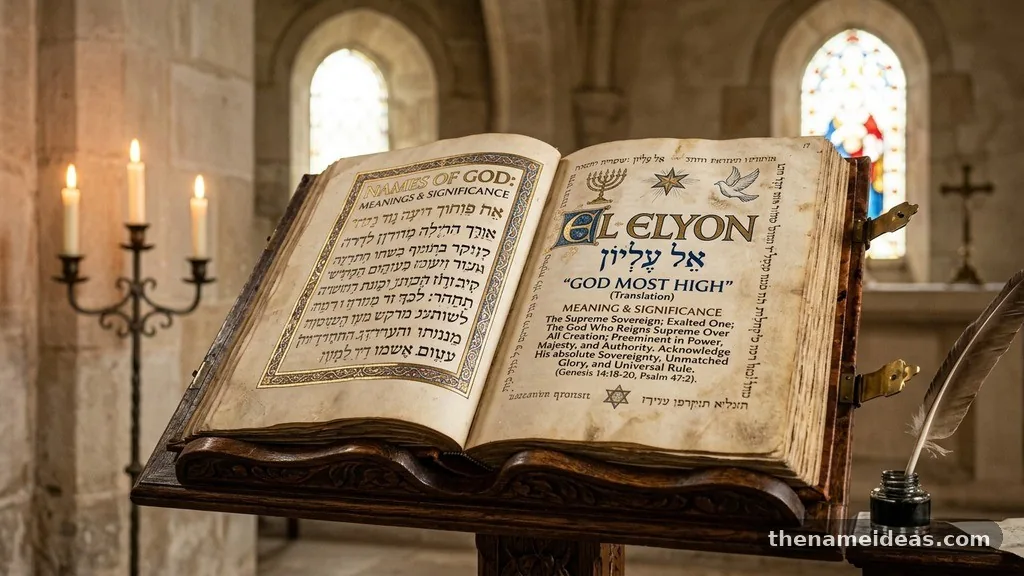
El Elyon means “God Most High.” Genesis 14 presents this title in the account of Melchizedek, who blesses Abram by the Most High God, “possessor of heaven and earth” in the KJV.
The title emphasizes supremacy. God is not one regional power among many competing authorities; he is described as above every ruler, nation, spiritual power, and created thing. The name is especially meaningful in passages concerned with kingship, blessing, judgment, and the boundaries of nations.
El Shaddai: God Almighty
El Shaddai is commonly translated “God Almighty.” In Genesis 17:1, God appears to Abram and identifies himself by this name before confirming the covenant and changing Abram’s name to Abraham.
The title is connected with God’s ability to accomplish what human strength cannot. Abraham and Sarah were old when God promised that their family would become a great nation, so El Shaddai carries a strong association with covenant power and divine sufficiency.
El Olam: The Everlasting God
El Olam means “Everlasting God” or “Eternal God.” Abraham calls on the everlasting God in Genesis 21:33 after making a covenant at Beersheba.
This name places human events inside a larger timescale. Families change, rulers rise and fall, and circumstances shift, but God’s existence and faithfulness do not depend on a temporary political or personal situation.
El Roi: The God Who Sees
El Roi is associated with Hagar’s encounter with God in Genesis 16. After being mistreated and fleeing into the wilderness, Hagar recognizes that God had seen her distress.
The name does not mean that God merely observes events from a distance. In the story, divine seeing leads to communication, promise, and direction. El Roi speaks to people who feel overlooked, displaced, or forgotten by the families and communities around them.
YHWH, Jehovah, and the Covenant Name
YHWH is the four-letter Hebrew form commonly called the Tetragrammaton. English Bibles have represented it in several ways, including Yahweh, Jehovah, and “LORD” in capital letters.
In Exodus 3, Moses asks what he should tell Israel when they ask which God has sent him. God answers with the phrase commonly translated “I AM THAT I AM” in the KJV, followed by the instruction to say that “I AM” has sent him.
The passage connects God’s name with existence, presence, and covenant faithfulness. He is not a deity who appears only for one crisis and then disappears. The name points to the God who is present with his people and remains faithful to his promises.
Why Some Bibles Use “LORD”
Many English translations use LORD in small capitals to distinguish YHWH from the Hebrew word Adonai, usually translated “Lord.” This editorial choice helps readers recognize an important difference that can be hidden when both words simply appear as “Lord.”
The convention is not meant to suggest that the word is shouted. It signals that the underlying Hebrew text contains the covenant name rather than the ordinary title for a master or ruler.
The form “Jehovah” developed through a historical combination involving the consonants of YHWH and vowel markings associated with Adonai. “Yahweh” is widely used in academic discussion as a reconstruction of the ancient pronunciation, although the original pronunciation cannot be established with absolute certainty.
Jehovah-Raah: The LORD My Shepherd
Jehovah-Raah, also written Jehovah Rohi or Yahweh-Raah, reflects the language of Psalm 23: “The LORD is my shepherd” (KJV). The image is personal and practical: a shepherd leads, feeds, protects, and searches for vulnerable animals.
Psalm 23 moves from green pastures and still waters to dark valleys and the presence of enemies. The title therefore includes more than comfort. It portrays God as a guide who remains responsible for his people in both peaceful and threatening places.
Jehovah Jireh: The LORD Will Provide
Jehovah Jireh appears in Genesis 22:14 after God provides a ram for Abraham instead of Isaac. The expression is often translated “The LORD will provide,” although the Hebrew wording can also carry the sense that the LORD will see to the need.
This name should not be reduced to a promise of immediate material success. In its original story, it appears within a demanding test of faith, a divine prohibition against sacrificing Isaac, and the provision of an alternative offering. The central idea is God’s provision within his covenant purpose.
Jehovah Rapha: The LORD Who Heals
Jehovah Rapha comes from Exodus 15:26, where God identifies himself as the one who heals Israel. The verse follows the bitter-water episode at Marah, where God makes the water drinkable.
Healing in Scripture can involve the body, the community, the land, or a broken relationship. This title expresses God’s power to restore, while the surrounding passage also places healing within obedience, trust, and the covenant relationship.
Jehovah Nissi: The LORD My Banner
Jehovah Nissi appears in Exodus 17:15 after Israel’s battle with Amalek. Moses builds an altar and names it “The LORD is my banner” in the KJV.
A banner represented identity and rallying unity in ancient warfare. The title does not glorify military aggression; it directs attention away from human self-confidence and toward God as the source of Israel’s help and collective identity.
Names That Reveal Peace, Holiness, and Righteousness
Several biblical names describe what God gives or embodies rather than focusing mainly on creation or military authority. These titles are especially important in prayers and passages about fear, guilt, worship, justice, and restoration.
Jehovah Shalom: The LORD Is Peace
Jehovah Shalom is the name Gideon gives to an altar in Judges 6:24. Gideon has encountered the angel of the LORD and fears that he will die, but God reassures him. The altar’s name records peace in the middle of danger.
In the Bible, shalom means more than the absence of conflict. It can include wholeness, safety, soundness, reconciliation, and well-being. Jehovah Shalom therefore points to God as the giver of restored life rather than merely a temporary feeling of calm.
Jehovah Tsidkenu: The LORD Our Righteousness
Jehovah Tsidkenu means “The LORD our righteousness.” It appears in Jeremiah 23:6 in a prophecy about a righteous king from David’s line, and a related form appears in Jeremiah 33:16.
The title addresses a serious biblical concern: human rulers and people may fail to practice justice, but God’s saving work is associated with righteousness. The name does not praise human moral achievement. It directs hope toward the LORD as the source and standard of what is right.
Jehovah M’Kaddesh: The LORD Who Sanctifies
Jehovah M’Kaddesh, also written Jehovah Mekoddishkem, means “The LORD who sanctifies you.” The expression appears in passages such as Exodus 31:13 and Leviticus 20:8.
To sanctify means to set apart as holy. In these passages, holiness is not presented as a human project detached from God; the LORD is the one who sanctifies his people. The name connects worship, identity, obedience, and belonging.
Qadosh Israel: The Holy One of Israel
The Holy One of Israel is one of Isaiah’s repeated titles for God. It combines holiness with covenant relationship: God is not simply “holy” in an abstract sense, but the Holy One connected with Israel’s calling, judgment, rescue, and future hope.
Isaiah uses this title in both warning and comfort. The same holiness that exposes injustice also guarantees that God will not abandon truth or treat evil as insignificant.
Abba and Father
Father is a major biblical title for God, and the Aramaic term Abba appears in the New Testament. In Mark 14:36, Jesus addresses God as “Abba, Father” in prayer at Gethsemane, and Paul uses the term in Romans 8:15 and Galatians 4:6.
Abba should not be flattened into a childish nickname. It expresses intimate trust while retaining reverence, especially in a passage involving suffering, obedience, adoption, and the work of the Holy Spirit.
Names of God as Shepherd, King, Rock, and Redeemer
Some of the most memorable names of God are images drawn from ordinary life in the ancient world. A shepherd, king, fortress, rock, and redeemer each carried specific social or political meaning for biblical audiences.
Shepherd
The title Shepherd appears throughout the Psalms and prophetic books. Psalm 23 presents the LORD as the shepherd who leads and protects, while Ezekiel 34 contrasts God’s care with the failure of Israel’s irresponsible leaders.
The shepherd image also carries a leadership critique. Human rulers are judged by whether they feed and defend the vulnerable rather than exploit them. God’s shepherding character therefore includes compassion, accountability, direction, and justice.
King of Kings and Lord of Lords
King of kings and Lord of lords express supreme authority. These titles appear in passages such as Deuteronomy 10:17, Psalm 136:3, and Revelation 19:16.
The language matters because biblical faith is not limited to private spirituality. God’s authority reaches kings, governments, armies, economic systems, and every human institution. The titles challenge rulers who treat power as absolute.
Rock and Fortress
Rock and Fortress are prominent in the Psalms. Psalm 18 describes God as a rock, fortress, deliverer, shield, and strong refuge after David’s rescue from enemies.
A rock suggests stability and dependable ground, while a fortress suggests protection within danger. These names do not promise that believers will never face trouble. They describe where trust is placed when trouble comes.
Redeemer
Redeemer is especially important in the book of Isaiah and in the story of Ruth. In ancient Israel, a redeemer could act on behalf of a family member by recovering property, protecting family interests, or addressing severe vulnerability.
When God is called Redeemer, the title presents him as one who acts to rescue, restore, and reclaim. It links personal salvation with justice, family responsibility, exile, and the renewal of a people.
Ancient of Days
Ancient of Days appears in Daniel 7. The title emphasizes God’s eternal authority in a vision where violent earthly kingdoms rise and fall before divine judgment.
Unlike a name that highlights nearness, this title stresses age beyond measurement, wisdom, and judicial authority. It reminds readers that history is not finally controlled by the most aggressive empire of the moment.
Names and Titles of God in the Psalms and Prophets
The Psalms are a rich source for biblical names of God because they preserve songs of praise, lament, confession, thanksgiving, and confidence. A single psalm may use several titles to describe one relationship from different angles.
For example, Psalm 18 calls God a rock, fortress, deliverer, shield, horn of salvation, and high tower. These are not random poetic decorations. They answer different forms of danger: pursuit, attack, instability, accusation, and fear.
- Light: God gives guidance and salvation, especially in passages where darkness represents fear or confusion.
- Shield: God protects and receives the trust of those who face danger.
- Strong Tower: God is portrayed as a secure refuge against hostile forces.
- Living God: God is distinguished from lifeless idols and imaginary powers.
- Judge of All the Earth: God possesses the authority to judge nations and individuals justly.
- Hope of Israel: God is the source of future confidence during national crisis and exile.
- Refuge: God provides protection and shelter for those who call upon him.
- Portion: God himself is described as the inheritance and lasting possession of his people.
Light has a particularly broad role in Scripture. Psalm 27:1 calls the LORD “my light and my salvation” in the KJV, connecting illumination with rescue. Isaiah also uses light to describe God’s saving work among people living in darkness.
Living God appears in contrast with idols and false objects of worship. Jeremiah 10:10 calls the LORD the true God and the living God, while Joshua 3:10 uses the title to assure Israel that God is present and active among them.
Judge of all the earth appears in Abraham’s question in Genesis 18:25: “Shall not the Judge of all the earth do right?” The title carries moral seriousness. God’s authority is joined to the expectation that judgment will be right, not arbitrary.
Prophetic titles also address national failure. Isaiah’s “Holy One of Israel,” Jeremiah’s “Hope of Israel,” and Ezekiel’s repeated concern for God’s name show that the names of God are tied to public justice, worship, community identity, and the future of nations.
Names of God in the New Testament
The New Testament continues the Old Testament pattern of revealing God through names, titles, and descriptions. It also places special emphasis on Jesus Christ as Lord, Word, Savior, Son of God, Messiah, and image of the invisible God.
Lord is one of the central titles. In the Greek New Testament, the word Kyrios can mean master or lord, but its use in particular passages also echoes the Old Testament language about the LORD. Context matters, especially in quotations from the Hebrew Scriptures.
Father and Holy Father
Jesus frequently speaks of God as Father. The title appears in prayers, teachings about providence, discussions of forgiveness, and instructions about private worship. It expresses relationship, but it also includes authority and holiness.
In John 17:11, Jesus addresses God as “Holy Father,” combining intimacy with reverence. That pairing guards against two opposite errors: imagining God as distant and unknowable, or treating him as familiar in a careless way.
Alpha and Omega
Alpha and Omega are the first and last letters of the Greek alphabet. Revelation uses the title to communicate that God encompasses the beginning and the end, the full scope of history.
The title appears alongside language about the one “which is, and which was, and which is to come” in the KJV. It speaks to permanence and final authority, particularly in a book shaped by persecution, judgment, worship, and hope.
Creator and Sustainer
The New Testament describes God as Creator and presents creation as dependent on his continuing will. Acts 17:24–25, for example, describes God as the Lord of heaven and earth who gives life and breath to all.
This teaching has practical significance. Human life is not self-created, and the world is not merely raw material for unlimited exploitation. The Creator title supports humility, gratitude, responsibility, and care for other people and the created order.
Immanuel
Immanuel means “God with us.” Matthew 1:23 connects the name with Isaiah’s prophecy and applies it to Jesus, presenting his arrival as a sign of God’s presence with his people.
The name is not simply a comforting phrase. It sits within the biblical story of promise, deliverance, incarnation, suffering, and redemption. “With us” includes God’s presence in human weakness and history, not only in moments of visible success.
How to Study the Names of God Responsibly
Many devotional resources list ten, twelve, thirty, seventy-two, or one hundred names of God. These lists can be useful, but they often combine different categories: Hebrew names, descriptive titles, metaphors, attributes, and names used for Jesus or the Holy Spirit.
That does not automatically make a list wrong. It does mean readers should ask what kind of list they are reading. “Names of God in the Bible” can refer narrowly to explicit names, or broadly to every recurring title and image used to describe God.
Start With the Passage
Read the entire passage where a name appears. Genesis 22:14 means more after reading the account of Abraham, Isaac, the command, the intervention, and the altar. A dictionary definition alone cannot supply the full theological meaning.
Check related verses as well. The same title may carry different emphasis in a psalm, prophecy, historical narrative, or New Testament quotation. Meaning grows through usage.
Compare Translations Carefully
Different translations may use LORD, Lord, Yahweh, Jehovah, or a descriptive phrase. Comparing a formal translation such as the KJV or WEB with a modern translation such as the NIV can reveal where an English rendering is interpreting Hebrew or Greek vocabulary.
For readers who want a reference tool, the Bible Odyssey resource from the Society of Biblical Literature offers background articles on biblical language, history, and interpretation. Use any reference alongside the actual Scripture passage rather than replacing the passage with a word study.
Distinguish Name, Title, and Attribute
A useful study method is to place terms into three broad groups. Personal or covenant names include YHWH; titles include King and Judge; attributes include holiness, mercy, wisdom, and faithfulness.
The categories can overlap. “Holy One of Israel” is both a title and a description, while “Redeemer” is a title that also explains what God does. The goal is clarity, not rigid classification.
| Study question | Why it matters | Example |
|---|---|---|
| Where does the term appear? | Context shapes meaning. | Jehovah Shalom in Judges 6 |
| What language is behind it? | English forms may conceal distinctions. | YHWH and Adonai |
| Is it a name or title? | It prevents oversimplified lists. | “Rock” as a metaphorical title |
| What problem does it address? | It reveals the pastoral purpose. | El Roi for Hagar’s distress |
| How does Scripture reuse it? | Repeated use develops theology. | Shepherd in Psalms and Ezekiel |
Why the Names of God Matter for Faith and Prayer
The names of God give language to prayer. Someone facing fear may pray to the Shepherd and Refuge; someone seeking forgiveness may focus on God’s mercy and righteousness; someone confronting injustice may remember the Judge of all the earth.
This does not mean that a particular Hebrew phrase works as a spiritual formula. Scripture does not teach that repeating Jehovah Jireh or El Shaddai mechanically guarantees a desired outcome. The significance comes from trusting the God whom the name reveals.
The names also correct incomplete ideas about God. A person who thinks only of divine power may need to consider God as Shepherd and Father. Someone who focuses only on comfort must also reckon with the Holy One and righteous Judge.
They shape character as well. If God is described as just, believers are called to practice justice; if God is merciful, they are called to show mercy; if God is faithful, they are challenged to keep their promises and care for their families and neighbors.
The names can also strengthen communities. A church, Bible study, or family devotional may study one name each week, read its primary passages, compare translations, and discuss how the title appears in worship and daily decisions.
Common Misunderstandings About Biblical Names
One common mistake is treating every popular list as if it were a direct quotation from the Bible. Some lists include names from later Jewish tradition, devotional language, or theological descriptions that are meaningful but not stated as formal biblical names.
A second mistake is assuming that every compound title has the same grammatical structure. Jehovah Jireh, Jehovah Rapha, and Jehovah Nissi are traditional English forms based on Hebrew expressions, but their translations may differ slightly between scholars and Bible versions.
Another error is taking a metaphor in isolation. Calling God a consuming fire, for example, must be read within passages about holiness and judgment. Calling God a rock should not be used to erase the biblical emphasis on compassion, hearing, and personal relationship.
Readers should also avoid using names as charms. The Bible presents God as personal and free, not as a force controlled by correct pronunciation. A name points toward God; it does not place God under human control.
Finally, do not confuse linguistic certainty with spiritual certainty. The exact ancient pronunciation of YHWH is debated, but the biblical message about God’s covenant faithfulness is not dependent on solving every pronunciation question.
Frequently Asked Questions About the Names of God
What are the most important names of God in the Bible?
Important names and titles include Elohim, YHWH, El Shaddai, El Elyon, Jehovah Jireh, Jehovah Rapha, Jehovah Shalom, Shepherd, Redeemer, King, Rock, Father, and Holy One of Israel. “Most important” depends on whether the focus is creation, covenant, provision, healing, holiness, or salvation.
Are Yahweh and Jehovah the same name?
They refer to the same Hebrew divine name, YHWH, but they represent different approaches to pronunciation and transliteration. Yahweh is common in modern academic writing, while Jehovah became established through a historical combination of the consonants of YHWH with vowel markings associated with Adonai.
What is the difference between Elohim and Yahweh?
Elohim is a Hebrew term commonly translated “God” and is strongly associated with divine power and creation. Yahweh represents the covenant name revealed in Exodus 3 and emphasizes God’s enduring identity and faithfulness. The two terms can appear in different contexts and sometimes work together.
How many names of God are there?
There is no single universally accepted number. Some lists count only explicit names, while others include titles, metaphors, compound expressions, and New Testament descriptions. That is why devotional lists may claim ten, thirty, seventy-two, or one hundred names without using exactly the same criteria.
Can I use the names of God in personal prayer?
Yes, biblical names and titles can guide personal prayer when they are used thoughtfully. Read the passage first, understand its context, and address God in a way that reflects the truth of the name rather than treating the phrase as a guaranteed formula.
Conclusion
The Names of God bring together the Bible’s teaching about creation, covenant, holiness, mercy, provision, justice, and presence. Elohim points to divine power, YHWH to covenant faithfulness, and titles such as Shepherd, Rock, Redeemer, and Father show how God relates to people in concrete circumstances.
For a meaningful study, choose one name, read its main passages, compare a few translations, and ask what the name reveals about God’s character and your response. The Names of God are not merely a collection of ancient terms; they invite careful reading, honest prayer, and a deeper understanding of the God described through Scripture.