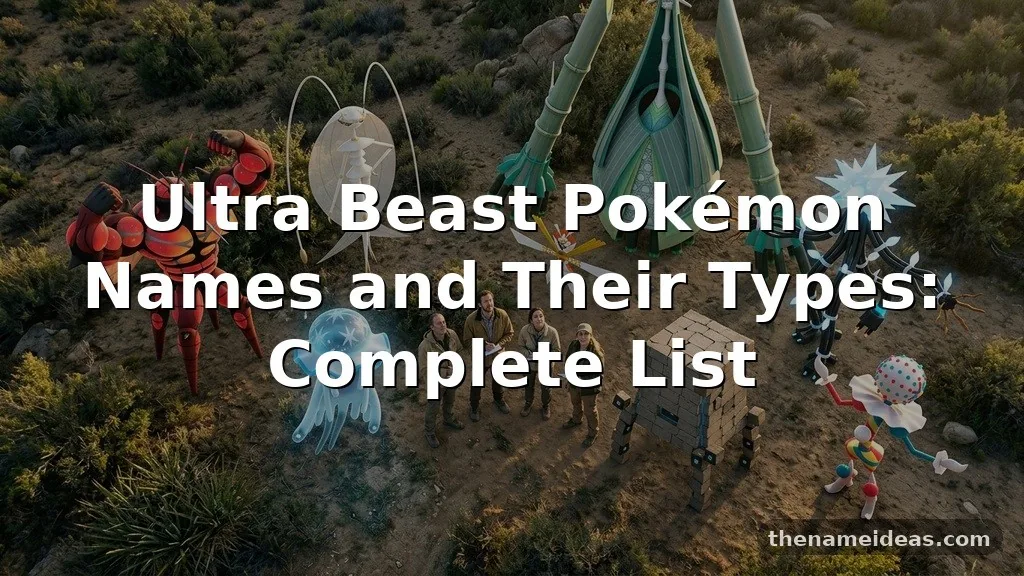
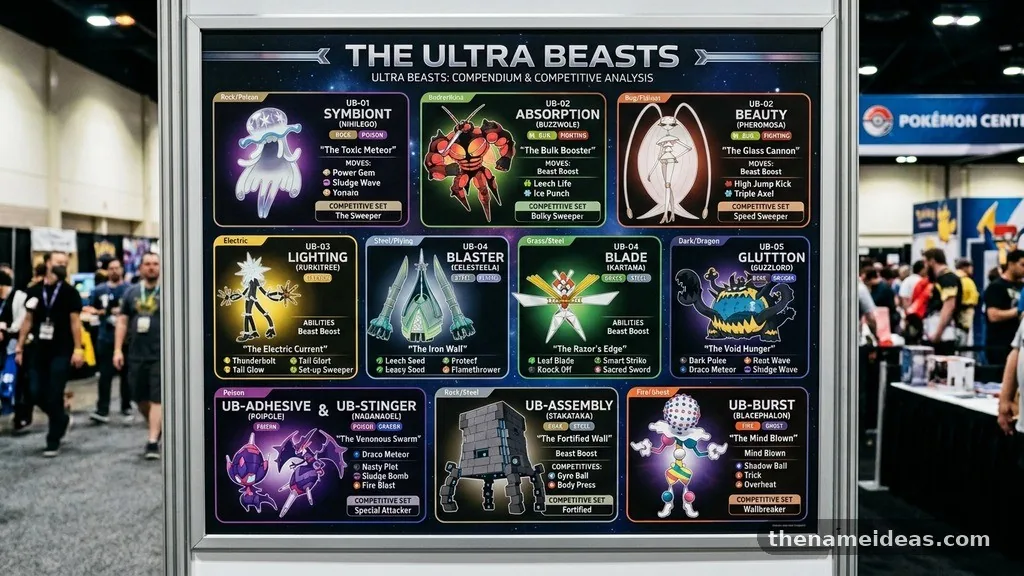
For anyone searching for Ultra Beast Pokémon names and their types, the key fact is that these creatures come from Ultra Space and each has a defined Pokémon type combination. The official group contains 11 Ultra Beasts: Nihilego, Buzzwole, Pheromosa, Xurkitree, Celesteela, Kartana, Guzzlord, Stakataka, Blacephalon, Poipole, and Naganadel.
Their designs range from parasitic jellyfish and towering steel structures to insectoid fighters and clown-like fire spirits. The list below explains every type, ability, origin detail, and useful naming idea for gaming clans, teams, usernames, and online communities.
You’ll also find the important distinction between Ultra Beasts and Necrozma, plus practical ways to turn this unusual Pokémon naming style into a memorable clan identity without simply copying a character’s name.
All 11 Ultra Beasts at a Glance
The Ultra Beasts first became prominent in Pokémon Sun and Pokémon Moon, although later games expanded where players could encounter them. They are not one single biological family with one shared type; instead, each creature has a distinctive typing, design language, and battle role.
| Ultra Beast | Type | Generation introduced | Signature ability |
|---|---|---|---|
| Nihilego | Rock / Poison | Generation VII | Beast Boost |
| Buzzwole | Bug / Fighting | Generation VII | Beast Boost |
| Pheromosa | Bug / Fighting | Generation VII | Beast Boost |
| Xurkitree | Electric | Generation VII | Beast Boost |
| Celesteela | Steel / Flying | Generation VII | Beast Boost |
| Kartana | Grass / Steel | Generation VII | Beast Boost |
| Guzzlord | Dark / Dragon | Generation VII | Beast Boost |
| Stakataka | Rock / Steel | Generation VII | Beast Boost |
| Blacephalon | Fire / Ghost | Generation VII | Beast Boost |
| Poipole | Poison | Generation VII | Beast Boost |
| Naganadel | Poison / Dragon | Generation VII | Beast Boost |
Every recognized Ultra Beast has the ability Beast Boost. After an Ultra Beast knocks out another Pokémon, Beast Boost raises the user’s highest stat, which can turn a successful attack into a larger threat as a battle continues.
The table uses the standard modern type classifications. For official terminology and game-specific material, readers can consult the official Pokémon information about the Ultra Beasts.
What Makes a Pokémon an Ultra Beast?
Ultra Beasts are extradimensional Pokémon associated with Ultra Space, a network of strange worlds and wormholes connected to the Pokémon world. They are not simply rare Pokémon with unusual appearances. Their identity is tied to their ability to cross between dimensions and to the danger they may pose after entering a new environment.
In the Alola story, the creatures arrive through Ultra Wormholes. Their unfamiliar biology explains why characters treat them as special threats rather than ordinary wild Pokémon, even though they still follow the basic rules of Pokémon battles.
The term “Ultra Beast” is a classification used in the story and game mechanics, not a type like Water, Fire, or Psychic. That distinction matters because an Ultra Beast can be Rock/Poison, Electric, Grass/Steel, or any of several other combinations.
Players also encounter special capture equipment connected with this theme. Beast Balls are designed with Ultra Beasts in mind, although their effectiveness differs depending on the target and the game. Poipole is especially notable because it can be obtained as a gift in some game contexts rather than appearing exactly like the roaming Ultra Beasts.
Why the designs feel so different
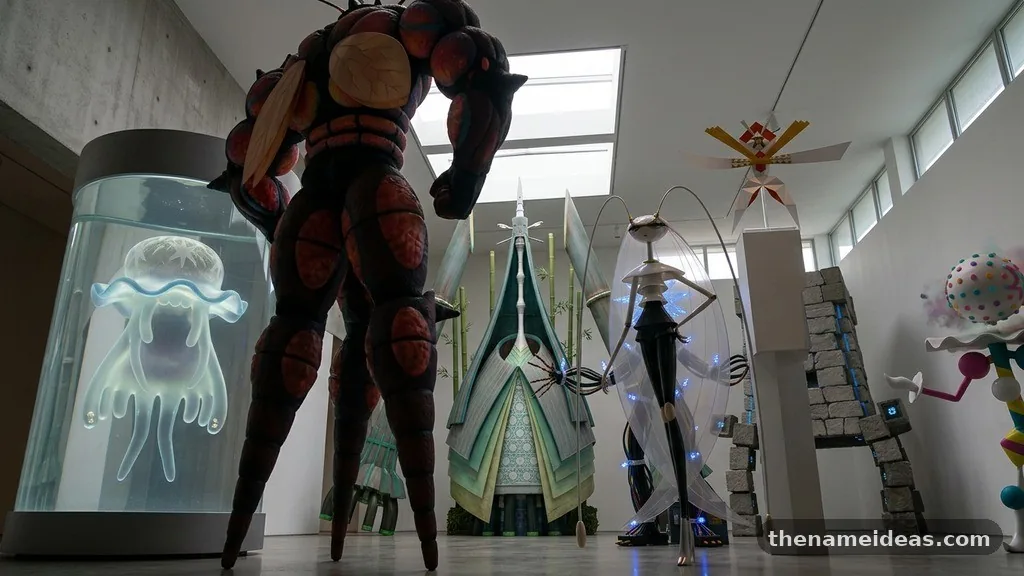
The visual contrast is deliberate. Nihilego resembles a translucent sea organism, Buzzwole and Pheromosa use sharply different insect-inspired body shapes, while Xurkitree looks like a living arrangement of cables and lights.
Celesteela has the appearance of a giant steel-and-bamboo rocket, and Kartana resembles a folded paper warrior. Stakataka is built from individual stone-like units, while Blacephalon turns theatrical performance and explosive movement into a battle design.
These designs give the group a useful naming vocabulary: alien biology, dimensional travel, strange architecture, cosmic weather, poisonous organisms, and impossible machinery. That vocabulary works well for a clan or Discord identity because it suggests a shared world without requiring every member to use the same character.
Ultra Beast Names and Types Explained
Nihilego — Rock and Poison
Nihilego is a parasitic, jellyfish-like Ultra Beast with the Rock/Poison typing. Its name and appearance suggest something delicate at first glance, but its story role involves manipulation, toxins, and an unsettling connection to living hosts.
Its typing creates an unusual identity. Rock gives it a mineral quality, while Poison adds danger and contamination, making Nihilego-inspired names suitable for mysterious, tactical, or science-fiction groups.
- Nihilego: Rock / Poison
- Useful themes: glass, venom, parasites, crystals, deep space
- Clan-style ideas: Glass Venom, Hollow Orbit, Toxic Prism
Buzzwole and Pheromosa — Bug and Fighting
Buzzwole and Pheromosa share the Bug/Fighting typing, but their designs communicate opposite personalities. Buzzwole is muscular, imposing, and physically dominant, whereas Pheromosa is sleek, elegant, and extremely fast.
This pairing shows how one type combination can support two different team identities. A group that values power might draw from Buzzwole’s visual language, while a speed-focused squad could borrow Pheromosa’s themes of precision, movement, and controlled elegance.
- Buzzwole: Bug / Fighting; suited to strength-based or gym-inspired themes
- Pheromosa: Bug / Fighting; suited to speed, agility, and refined aesthetics
- Clan-style ideas: Iron Pollen, Velvet Impact, Needle Rush
Xurkitree — Electric
Xurkitree is a pure Electric-type Ultra Beast whose body resembles tangled power cables decorated with glowing lights. The design turns electricity infrastructure into a living creature, making it one of the clearest examples of an Ultra Beast that feels completely alien.
It works particularly well as inspiration for a technology-focused gaming group. Names based on current, circuits, signal interference, and artificial light can sound modern without relying on overused words such as “cyber” or “quantum.”
- Xurkitree: Electric
- Useful themes: circuitry, voltage, power grids, neon, interference
- Clan-style ideas: Static Orchard, Livewire Pact, Signal Bloom
Celesteela and Kartana — Steel-based Ultra Beasts
Celesteela is Steel/Flying, combining a heavy metallic body with a design inspired by rockets and bamboo. Kartana is Grass/Steel and has a much smaller, blade-like form based on folded paper and the image of a miniature warrior.
Their shared Steel connection does not make them interchangeable. Celesteela suggests endurance, height, launch systems, and fortified defense, while Kartana suggests sharpness, discipline, craftsmanship, and sudden attacks.
- Celesteela: Steel / Flying; useful for space, fortress, and aviation themes
- Kartana: Grass / Steel; useful for blade, paper, forest, and precision themes
- Clan-style ideas: Alloy Canopy, Paper Edge, High-Orbit Foundry
Guzzlord — Dark and Dragon
Guzzlord is a Dark/Dragon Ultra Beast characterized by enormous size, an insatiable appetite, and a body built around a massive mouth. Its design is intentionally excessive, making it a strong choice for groups that want an intimidating or darkly comic identity.
The creature’s type combination supports a serious competitive tone, but its exaggerated hunger also creates room for humor. A group can use the idea of endless consumption without copying the Pokémon’s name directly.
- Guzzlord: Dark / Dragon
- Useful themes: hunger, ruins, abyssal power, hoarding, colossal scale
- Clan-style ideas: Maw of Midnight, Feast Protocol, Ruin Appetite
Stakataka and Blacephalon — Rock/Steel and Fire/Ghost
Stakataka is Rock/Steel and appears as a towering structure made from many individual stone-like entities. Its name and silhouette suggest a moving fortress, so it suits defensive teams, building communities, and groups that value coordination over individual showmanship.
Blacephalon is Fire/Ghost, a striking combination reflected in its theatrical body and explosive head. It supports names built around fireworks, stagecraft, masks, illusion, and controlled chaos.
- Stakataka: Rock / Steel; suited to fortress and formation themes
- Blacephalon: Fire / Ghost; suited to carnival, spectacle, and explosive themes
- Clan-style ideas: Bastion Column, Ashen Masquerade, Fuse Theatre
Poipole and Naganadel — Poison and Poison/Dragon
Poipole is a Poison-type Ultra Beast with a more youthful and expressive appearance than most of the group. It evolves into Naganadel, which gains the Dragon type and takes on a larger, more threatening design with venom-based attack imagery.
The pair is useful for naming groups that want a progression theme. A casual community might use Poipole-inspired ideas, while a competitive team could draw on Naganadel’s transformation from a curious creature into a dangerous aerial attacker.
- Poipole: Poison; suited to playful alien, ink, and laboratory themes
- Naganadel: Poison / Dragon; suited to serpents, venom, wings, and evolution
- Clan-style ideas: Inkling Orbit, Venom Spiral, Evolute Fang
Ultra Beast-Inspired Clan Names for Gaming Groups
Ultra Beast themes are especially effective for gaming clans because they already contain a strong concept: a group arriving from outside the normal world. The best clan names use that feeling while remaining easy to type and pronounce.
These suggestions are original ideas inspired by dimensional travel, alien biology, unusual types, and the contrast between beauty and danger. They are not official Pokémon names, and a group should check availability on its chosen platform before adopting one.
Cool and competitive names
- Wormhole Directive
- Obsidian Circuit
- Beyond the Rift
- Iron Bloom
- Venom Meridian
- Skyforge Signal
- Riftbound Seven
- Glassline Order
- Orbit Reavers
- Chrome Prowlers
- Redshift Assembly
- Feral Aperture
These work best for competitive gaming, ranked multiplayer, and esports-style branding because they sound organized without being too formal. Names such as “Wormhole Directive” and “Redshift Assembly” also leave room for a clan tag that is short and recognizable.
Dark, intimidating, and mysterious names
- Black Aperture
- Hollow Singularity
- Grave Orbit
- Violet Ruin
- Null Cathedral
- Nightfall Specimen
- Wicked Parallax
- Abyssal Relay
- Silent Contagion
- Fang at Perihelion
- Buried Wormhole
- Deadlight Union
Dark names suit teams that want an imposing first impression, but restraint matters. A short, unusual phrase often sounds more credible than a crowded name containing several familiar threat words.
Funny and casual names
- Wrong Dimension Again
- Beast Ball Missed
- Mostly Harmless Aliens
- We Read the Weakness Chart
- Portal Snack Break
- Accidental Invaders
- Catch Us Loading
- Cosmic Wi-Fi Problems
- Zero Plan, Full Send
- Not From Around Here
- Respawned Through Space
- Type Matchup Optional
Funny clan names are a better fit for friends, social gaming communities, co-op groups, and creators who want an approachable identity. They can also make voice-chat culture feel less formal, particularly when the group’s reputation is built around jokes rather than tournament results.
Short names and clan tags
- Rifted
- Veyra
- Oculon
- Brimox
- Ultrane
- Ferrox
- Nyxline
- Gloam
- Vantae
- Orvex
- Prismark
- Kaivolt
Short names are easier to remember, but they can be harder to make distinctive. Before settling on one, say it aloud, check whether people spell it correctly after hearing it once, and see whether it remains readable as a username or four-character clan tag.
Fantasy, Nature, and Aesthetic Ultra Beast Names
Not every Ultra Beast-inspired identity needs to sound aggressive. The designs also support fantasy, nature, elemental, and aesthetic naming styles that are better suited to role-playing guilds, art communities, friendly servers, and teams that want a distinctive visual theme.
Fantasy and mythical suggestions
- Wyrm Beyond the Gate
- Moonlit Reliquary
- Serpent of the Ninth Sky
- Runebound Exiles
- Lanterns of Elsewhere
- Velvet Basilisk
- Starwell Court
- Mythic Paradox
- Griffin at the Rift
- Oracle of the Hollow Moon
Fantasy names work because they imply lore. “Moonlit Reliquary” sounds like a guild with history, while “Serpent of the Ninth Sky” gives a team an image that could extend into banners, icons, and member titles.
Nature and elemental suggestions
- Ember Canopy
- Saltwind Circle
- Thunderroot
- Frostglass Grove
- Wildfire Meridian
- Verdant Voltage
- Rainshadow Kin
- Basalt Tide
- Sunken Briar
- Cloudstone Pact
Nature-based names can soften the alien side of the concept while preserving unusual imagery. They are a good choice when a clan wants an aesthetic profile rather than a threatening one, especially in games built around exploration, survival, crafting, or role-playing.
Polished and professional names
- Meridian Collective
- Axis Beyond
- Northstar Division
- Fifth Aperture
- Vector House
- Parallax Group
- Oriel Strategy
- Frontier Standard
- Lucent Assembly
- Outerline Guild
Professional names are useful for esports organizations, sponsored teams, and communities that may appear on social media, tournament brackets, or merchandise. They avoid slang and excessive menace, which makes them easier to carry across different games and audiences.
How Ultra Beast Types Shape a Team Identity
A type can do more than describe battle mechanics. It can guide the tone, colors, vocabulary, and behavior that a gaming group wants to communicate.
| Type theme | Personality it suggests | Useful naming vocabulary | Best fit |
|---|---|---|---|
| Poison | Subtle, tactical, unpredictable | Venom, glass, ink, contagion | Strategy groups and dark communities |
| Fighting | Disciplined, direct, energetic | Impact, strike, circuit, charge | Competitive squads |
| Electric | Fast, modern, reactive | Signal, current, livewire, voltage | Action and technology-focused teams |
| Steel | Reliable, structured, resilient | Alloy, bastion, forge, column | Guilds and organized clans |
| Dark | Intimidating, secretive, forceful | Abyss, midnight, ruin, hollow | Ranked and competitive groups |
| Dragon | Legendary, powerful, ambitious | Wyrm, scale, crown, ancient | Fantasy teams and major communities |
| Fire | Expressive, explosive, confident | Fuse, ember, flare, ash | Social groups and aggressive squads |
For example, a serious competitive group might choose a Steel-based identity because it communicates structure and durability. A casual team that wants a memorable joke could choose a dimensional or Beast Ball reference instead of presenting itself as a fearsome tournament organization.
Strong naming usually comes from matching the name to the group’s actual behavior. A relaxed group with a frightening name can make the contrast funny, but a professional esports team may want a name that sounds credible when announced aloud.
Gaming and Clash of Clans-Style Naming
A general gaming clan name should remain flexible across multiplayer games, Discord servers, usernames, and social platforms. A game-specific name can be more direct, using terms associated with a particular battle system, base-building loop, guild structure, or competitive ladder.
Clash of Clans-style naming often favors compact, forceful identities that look good above a village, beside a player name, or in a war roster. Ultra Beast-inspired options such as “Iron Bloom,” “Wormhole Directive,” and “Maw of Midnight” can fit that style, but they are creative suggestions rather than names officially supported or guaranteed to be available in the game.
A name designed for a particular game should also reflect its community culture. A clan built around coordinated attacks may want a disciplined title, while a social group focused on donations, conversation, and shared progress can choose something warmer or more humorous.
Examples by gaming purpose
- Ranked multiplayer: Riftbound Seven, Obsidian Circuit, Glassline Order
- Base-building games: Bastion Column, Cloudstone Pact, Northstar Division
- Role-playing guilds: Moonlit Reliquary, Runebound Exiles, Starwell Court
- Co-op friend groups: Portal Snack Break, Mostly Harmless Aliens, Accidental Invaders
- Esports branding: Axis Beyond, Vector House, Redshift Assembly
- Discord communities: Lanterns of Elsewhere, Outerline Guild, Rainshadow Kin
Keeping the core name independent of one game can protect the group’s identity if members move from one title to another. A name that depends on one mechanic may be clever at first but confusing after the community changes games.
How to Choose a Memorable Clan Name
A memorable name usually has three qualities: it is easy to say, easy to type, and connected to a clear image. “Static Orchard,” for example, combines a familiar object with an unexpected technical idea, creating a phrase that is more distinctive than a generic name such as “Electric Warriors.”
Length matters, but shorter is not automatically better. A one-word name may be elegant, while a two- or three-word name can communicate a richer idea and provide better opportunities for logos, member ranks, and lore.
A practical selection process
- Choose the group’s main personality: competitive, funny, mysterious, friendly, elegant, or experimental.
- Select one visual world, such as Ultra Space, venom, machinery, celestial travel, ruins, or elemental nature.
- Generate several nouns and verbs connected to that world rather than combining the same familiar buzzwords.
- Say each candidate aloud and ask whether a new member could spell it after hearing it once.
- Test the name beside a username, a short clan tag, and a social profile title.
- Ask the full group to choose from a small final shortlist rather than voting on dozens of unfinished ideas.
Distinctive names often come from contrast. Pairing “glass” with “venom,” “orchard” with “static,” or “reliquary” with “moonlit” creates tension that makes the phrase easier to remember.
Another useful method is to borrow the structure of an Ultra Beast without borrowing its name. Think about an impossible creature, a strange habitat, or a force entering the ordinary world, then express that idea in fresh language.
Common Naming Mistakes to Avoid
The most common mistake is choosing a name that sounds powerful but says nothing specific. Words such as “elite,” “warrior,” and “legend” are familiar across gaming, so using several together can make a clan disappear into a crowded list.
Overcomplication causes a different problem. Excessive punctuation, unusual spelling, random numbers, and long strings of adjectives may make a name difficult to search, remember, or communicate in voice chat.
- Don’t choose a name that depends on a joke only the founding members understand.
- Don’t copy an official Pokémon name if the group wants an independent identity.
- Don’t assume a dramatic name will suit a relaxed or family-friendly community.
- Don’t use offensive references that could limit recruitment or public visibility.
- Don’t treat a generated suggestion as automatically available on every platform.
- Don’t ignore pronunciation; a name that looks good but sounds awkward may not last.
Before adopting a finalist, search the relevant game, Discord, and social platforms manually. Check whether the phrase is already associated with a different community, whether the intended spelling is available, and whether its abbreviation creates an unintended word.
It is also sensible to ask whether the name can survive a change in membership. A clan named after one player, one inside joke, or one temporary game mode may feel dated once the group grows.
Are Ultra Beasts the Same as Necrozma?
Necrozma is closely connected to Ultra Space and appears alongside Ultra Beasts in the Alola storyline, but it is generally treated as a separate Legendary Pokémon rather than one of the 11 official Ultra Beasts. Its connection to the Ultra Recon Squad, Ultra Wormholes, and the light-based story makes the distinction easy to miss.
That means a standard Ultra Beast Pokémon list includes Nihilego through Naganadel but does not normally add Necrozma. Necrozma’s forms, including Dusk Mane, Dawn Wings, and Ultra Necrozma, are separate from the Ultra Beast classification.
This difference is useful for naming. A group can use “Ultra Space” or “dimensional” themes without claiming that every related Pokémon is an Ultra Beast. Accurate terminology gives a gaming community a stronger identity, especially when members care about the series’ lore.
FAQ About Ultra Beast Pokémon Names and Types
What are the 11 Ultra Beasts in order?
The commonly listed 11 are Nihilego, Buzzwole, Pheromosa, Xurkitree, Celesteela, Kartana, Guzzlord, Stakataka, Blacephalon, Poipole, and Naganadel. The order can vary slightly depending on whether a source follows Pokédex numbering, release presentation, or story encounters, so the names matter more than a single ordering convention.
What are the different types of Ultra Beasts?
The Ultra Beasts use Rock, Poison, Bug, Fighting, Electric, Steel, Flying, Grass, Dark, Dragon, Fire, and Ghost types. None is defined by one shared elemental type; the group is connected by its extradimensional origin and Beast Boost ability.
Who is Ash’s Ultra Beast?
Ash’s Ultra Beast is Poipole, which later evolves into Naganadel. Poipole is notable because it becomes part of Ash’s team in the anime and develops a personal relationship with the group rather than appearing only as a mysterious invader.
Which Ultra Beast is the strongest?
There is no single answer for every battle format because base stats, moves, abilities, team support, and rules all matter. Competitive discussions often highlight different candidates for different roles: Pheromosa for speed, Celesteela for durability and utility, Guzzlord for bulk and offensive presence, and Naganadel for its Poison/Dragon combination.
Can Ultra Beast names be used for a gaming clan?
They can inspire a clan identity, but groups should check the rules and branding expectations of the platform or event they use. Creating an original variation such as “Glassline Order” or “Wormhole Directive” gives the community a more individual identity than using an official creature name alone.
Conclusion
Ultra Beast Pokémon names and their types are memorable because the group combines clear battle mechanics with unusual designs and an origin in Ultra Space. The official list contains 11 recognized Ultra Beasts, each with Beast Boost and a distinct type identity ranging from Electric Xurkitree to Fire/Ghost Blacephalon.
For a clan, guild, squad, or online community, the strongest approach is to borrow the themes rather than copy the characters: dimensional travel, alien biology, strange machinery, venom, steel, and cosmic danger. Compare the options with your group’s personality, test the spelling across platforms, and choose a name that still sounds natural when spoken aloud.